Showing posts with label politics and archaeology. Show all posts

Sunday, October 6, 2013

Pedicures: Interesting Things


Admittedly, I wasn’t all that interested in pedicures until I moved to New York City. Why are manicure-pedicures so extremely popular here? Why is it commonplace to get them done instead of taking care of your feet yourself?

Fish Pedicure
<http://i.usatoday.net/news/_photos/2008/07/01/
french-manicure-woman-horiz.jpg>
There are easily a few practical answers to these questions. First, wearing sandals around the City makes your feet downright filthy. (I can attest to this from personal experience.) Second, they are surprisingly affordable here! While there are more expensive and luxurious options, a 15$-25$ dollar manicure-pedicure is commonplace. Lastly, this city is geographically littered with nail salons. In conclusion, they are affordable, convenient, and they almost always take walk-ins.

Still, why do people do it? Why do we put paint on our nails at all? It doesn’t seem to make our nails function any better. So, what does it mean? I think that Danesi would agree that the practice of nail painting is a matter of Selfhood and that nail polish, itself, is part of our “material culture, namely, the system of objects that, as signs, convey specific types of meaning in our cultural context.” (61)
Detailed Manicure Designs
<http://www.allure.com/images/salon-spa-reviews/
new-york-city/2011/NYC_nails_valley_spa.jpg>

I am not the most savvy nail salon participant by any means, but the different body images signified by different nail coloring choices can be relatively straight forward and easy to process. Say you saw someone with a French manicure design on their toes, what would you think? Maybe that could signify that they are wealthy, classy, or organized? What about someone with bright hot pink toenails? Could they be feminine, young, outgoing, and/or flamboyant? What about someone with his or her toes and fingers painted black? What if they had extremely long acrylic extensions and colorful rhinestones glued on?

Whether or not you frequent a nail salon you probably have some thoughts about what those different stylized choices would say to you as the observer. Here is where semiotics can help us discuss this strange yet familiar phenomenon. According to Danesi, “The semiotic study of nonverbal behavior is a study of how people experience and define themselves through their bodies and objects. In most cultures, self-image is carved out and conveyed primarily as body image.” (65-66).
Example of French Manicure
<http://cdn.sheknows.com/articles/2013/01/
french-manicure-woman-horiz.jpg

By utilizing some terminology provided by Danesi, I would like to say that I think polished nails signal a gendered status and usually a feminine one. The iconicity of the French tipped manicure as “classy” is undeniable. The nature of the colors, shapes and styles of mani-pedis symbolize the identities that women (usually not always, of course) want to present to the world.

The semiotics of nail care is not only useful for unpacking individuals and their personal image. The industry of nail care is also extremely symbolic of New York’s political and social structure. It is perfectly reasonable to wonder why your nail-tech is usually Korean. It seems that nail salons are primarily (at least in popular culture) associated with Korean women and in return, Korean women with nail salons.

View from Pedicure Chair from Yelp post
<http://s3-media2.ak.yelpcdn.com/bphoto/
Gjg1pZ3f-uG04BrdY7Mcuw/l.jpg
Miliann Kang delves deeply into the meaning and social ramifications of the hunger for nail care that she believes women (primarily of New York) demonstrate. “While domination by Koreans of the nail salon niche in New York City is unusual in some ways, in other ways it reveals similar experiences among Asian immigrant women throughout the United States.” (3) She begs us to look beyond our familiar pop culture references of nail salons and see the true dynamics at play that influence a greater image of Korean immigrants.

In conclusion, the structures of meaning, body image and social structure associated with New York’s nail salons is a rich field for study even if it doesn’t seem to be at first glance.

[By Becky Fisher]

References:

Danesi, Marcel. Of Cigarettes, High Heels, and Other Interesting Things: An Introduction to Semiotics. New York: Palgrave Macmillan, 2008. Print.

Kang, Miliann. The Managed Hand: Race, Gender, and the Body in Beauty Service Work. Berkeley: University of California, 2010. Print.


Thursday, May 2, 2013

Unpacking the Lower East Side Tenement Museum


Graffiti and brass plaques adorn the steps to 97 Orchard Street
Full Disclosure: I spent all of last year interning at the Lower East Side Tenement Museum. While I originally signed on to a research position, the Collections Manager was in need of help in cataloguing artifacts in preparation for a collections move, and thus I spent much of last autumn the dusty ruinous basement of 97 Orchard Street. My experience taking an official “tour” this week left me fraught with images from my experience behind the scenes of the museum. The Lower East Side Tenement Museum is a collusion of narratives, artifacts, eras, and ruins. The Museum is quite different from many of the other museums that have been featured in this blog, and spoken about in class. The walls are not lined with display cases showcasing individual objects protected in an enclosure of controlled light and glass. There are no paintings with elaborate frames, guarded by gallery attendants who remind one not to use flash photography. There are no colossal halls demarcated by imposing classically architected columns. The LESTM is "simply" a tenement that has been restored to reflect specific eras and particular narratives. In order to be privy to the inside of 97 Orchard Street, one must buy a ticket to attend a guided tour, where they will join a dozen others in the (sometimes costumed) “retelling” of a family’s life within its walls over a century ago.
Orchard Street, location of the Lower East Side Tenement Museum

Emerging from the Upper West Side into Chinatown
Outdoor Fish Market
I headed down from the Upper West Side to emerge at the Grand Street station, right in the hub of Chinatown. I left the depths of the tunnels to the smell of the fish and fruit market. I expected the journey from the subway station to the Museum to be rather mundane, but the happenings around me certainly inspired temporally relevant questions. Although I had simply taken a subway, I was thrown into an area where English was not the language on signs, where the products being sold at the markets were mostly unfamiliar. I was thrown from an unthinking conduit and forced to be very present in my environment. The area where the museum sits is an odd mish-mash of older tenements, newer buildings, traditional Chinatown shops, gluten-free bakeries, futuristic graffiti and lots full of trash. It is an area where multiple places convene in one geographic locality, it is an area where people with specific mindsets build upon one another, smother old businesses, take over condemned buildings, and convene with the familiar. I’ve included a lot of images in this blog because I think they are show how multiple layers of cultures build upon one another and create this place of confluence. Parts of the neighborhood, particularly the "Earnest Sewn" store across the street, provide a playful interaction and mimicry of the insides of the Museum.

I entered the bookstore and purchased a ticket for the “Irish Outsiders” tour, which is described by the LESTM website in this way, “Experience the heart of the immigrant saga through the music of Irish America, then tour the restored home of the Moore family, Irish-Catholic immigrants who left their home in the Five Points to start a new life in Kleindeutschland. Explore how this family dealt with being 'outsiders' in 97 Orchard and how they coped with the death of their child in 1869.” I was instructed that I was not allowed to take pictures once I entered the building, as the museum needed to maintain a “certain image,” according to my Museum Educator. We entered the Museum through the backyard, where the toilets where located, and brought up to the fourth floor. This space has been kept in disarray, in ruin. Visitors are told about how “In 1988, Jacobson responded to a ‘for rent’ sign at 97 Orchard Street, and this fledgling museum settled onto a tenement storefront. This building proved to be the perfect location for a museum, with its upper floors untouched since the owner stopped renting apartments in 1935. After occupying the building for eight years, the Lower East Side Tenement Museum purchased 97 Orchard Street in 1996” (Dolkart 102). The wallpaper in the room that we were brought to showed layers of peeling, layers of families that had lived in those spaces.
On one side of LESTM, "Pop Karma," a gourmet popcorn store
On the other side, a residence home to LES locals
Iremember the first time I saw the disarray of the upper floors of the Museum I was absolutely enchanted. Last autumn, when I was not cataloguing in the basement, I was bringing the already catalogued items five flights up the fire escape and into the unoccupied rooms upstairs, so as to make room in the basement for a new exhibit. I romanticized about the eyes of those who had seen each different layer, about each family’s desire to cover up the walls of the previous owner and make it theirs. The walls are now covered in a sepia-colored collage of wood and molding material, no longer cared for by individual tenants, but used as space to house the unseen. The museum must maintain a certain image. It is jarring to enter such a space, “the key points of tension become visible, and he skeleton – the infrastructure on which all else hands – the pillars, keystones, support walls and beams stand while less sturdy material – the clothing, or the flesh of the building  - peels off” (Edensor 109). It is haunting. How does one react to a space that was so intimate to one, and now commoditized and hidden? I felt emotional for the space itself, for some respect that it had lost in the shifting of eras. I point towards Gavin Lucas’ idea of the emotional aspect of being immersed within a specific time. What if one is immersed in a place where the ghosts of multiple times, none close to your own, dwell? How can immersion in this space of intimacies of the past make one uncomfortable? Does the fact that this was a place of particular economic or social struggle, an immigrant home, make the feelings more resonant?
Photograph of a wall facing the museum on the opposite side of the street, with the same multi-layered effect
Upward view of multi-layered wall, which is next to a purposefully rugged aesthetic clothing store
"Earnest Sewn" the store that demonstrates this fetishization of authenticity and commodification of nostalgia
Layering of Graffiti and Stickers Nearby
Back on the fourth floor, where we were beginning the Irish Outsiders tour, we listened to popular Irish-American music projected from a Mac onto the dusty windows in the purposefully-preserved-as-found tenement. The Museum Educator turned eagerly towards us after listening to the folk song “Irish Need Not Apply” and asked us which immigrant group today reminded us of the Irish of yesteryears.


“Audience participation is encouraged!”

“Please, let’s make connections to today!”

“How is the narrative of the immigrant different or similar in the 21st century?!”

I felt uncomfortable making these connections. The narrative here that was being pushed was one of a blanket story that could be thrown over certain ethnic groups from different places, living in different times. Is politicizing a narrative the only way to make it relevant? Is it ethical to make these types of general statements? Was I disappointed by the injection of present politics while I was trying to immerse myself in the past? I'm not sure. The only person who answered was a woman from France who simply said “Muslims.” No one else had any thoughts to share for the remainder of the tour.

After leaving this room, we entered an apartment that was completely recreated with items from the 1860s. The Museum Educator told us the tale of the Moore family, their three daughters, and the death of the youngest, Agnes. There is the general narrative one can tell of Irish immigration, which in some ways is compelling enough – “coffin” ships, potato starvation by the British, discrimination and hatred from other immigrants. But how does the museum know what would be in their particular apartment? Or that this particular family lived here? Through discrete and sparse documents. There is the NYC directory, which places the family in this apartment; there are the baptismal certificates of the children, the death certificate of Agnes, and the 1870 census in which the family had moved 6 blocks south. These are the only documents used to create this tour, to craft this narrative of this specific family. These documents coupled with what is known about “swill milk” (milk that had chalk or ammonia in it to keep it from going bad and was the cause of many infant deaths during this age) were used to create a compelling story. Edensor remarks on the difficulty, “ to turn such ruined stories into official versions, potted narratives and fixings is almost impossible, for these tales rely upon unforeseen happenings, involuntary memories and revelations, immanent sensations and arbitrary pathways of conjecture and can never post as authoritative, never aim for closure” (161). Edensor remarks that this type of storytelling must not pretend to be “imperialistic” (164). What would Edensor think of the LESTM, with its multiple tours going on at the same time, these fragile narratives from different eras being represented in the same space once plagued by ruination?

The guided tour experience ended with the details of how an Irish Catholic would mourn the death of their child. The group entered the final room of the cramped tenement apartment to the recording of a woman’s melancholic singing. The windows are opened, and we are told that windows remain open three hours after death so that the soul might find its way from the body. The mirrors in the room are covered, and we are told it is a traditional belief that if such a soul sees oneself in the mirror, they might remain stuck on earth and unable to enter Heaven. Though it is 2013, I think the collective feeling in the room was one of sadness, of mourning. The tragedy of the death of a child knows no boundary in time. The nuances of tradition being followed are general rules, but the resonance is undeniable. This strange space, immersed in a room filled with 1860s items, hearing the wails of the grieving song, were more powerful than the voice of the Museum Educator. The hardships of immigrant life that the LESTM so strives to depict were most effectively deployed not by the voice of a 20-something docent, but by the flapping of the curtains on an open window. The “vibrance” contained in this material culture, these artifacts, was most powerful, as stated by Michael Shanks in The Archaeological Imagination.

Influential reads from the past
After this, we were guided downstairs and brought to the shop. As I perused the titles of books – children’s books, famously controversial books, newer books – which mostly focused on immigration, or poverty, the images of the open windows and covered mirrors did certainly haunt me, just as the layers of wallpaper did last year. Perhaps most eloquently stated, “it is also because ruins are rampantly haunted by a horde of absent presences, a series of signs of the past that cannot be categorized but intuitively grasped, can be read for significance but are ultimately evasive and elusive” (152).

I leave the museum with a renewed dizziness at the world around me, the confusing elements of living in a city with such defined conduits and yet so full of vibrancy and diversity. We are living among the past, the past is present in more ways than just the skeletal buildings that envelop us, the strangeness of living in a space with temporal, cultural, linguistic pluralities. The physical building itself is an artifact, a   mix of ruin and eras and narratives and agendas, with an undeniable agency and effect on those who visit it.


Sources Cited:

Dolkart, Andrew. Biography of a Tenement House in New York City: An Architectural History of 97 Orchard Street. Chicago, Il.: Center for American Places, 2012. Print.
Edensor, Tim. Industrial Ruins: Spaces, Aesthetics, and Materiality. Oxford [U.K.: Berg, 2005. Print.
Lucas, Gavin. The Archaeology of Time. London: Routledge, 2005. Print.
Shanks, Michael. The Archaeological Imagination. Walnut Creek, CA: Left Coast, 2012. Print.
www.tenement.org

All photographs by Emma Gilheany


Saturday, April 30, 2011

When Laws and State Historic Preservation Divisions Fail to Serve and Protect

As you read, I invite you to listen to Izrael Kamakawiwo'ole's moving song, "Hawai'i 78"


Kanaka Maoli (Native Hawaiian) Scholars Against Desecration: The Case of Naue


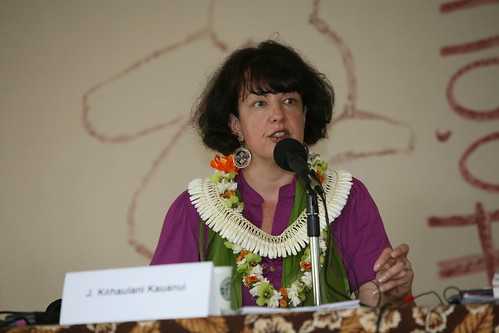
As the final speaker in the Ontologies of Exhumation lecture series, Native Hawaiian activist and scholar Dr. J. Kehualani Kauani, associate professor of American Studies and Anthropology at Wesleyan University, came to Columbia on April 21, 2011 for a session on Native Hawaiian indigenous politics surrounding the adverse effects of Hawaiian burial ground desecration in the form of architectural construction.

We examined the case of Naue, a beachfront along the northern shore of Kaua'i where real estate developer Joseph Brescia disturbed the grave of at least 30 known iwi kupuna (Hawaiian ancestral remains) - churned the ground with backhoes, crushing and mixing ancestral bones with sand and concrete - to build the foundation of a multimillion dollar home. The controversy lies within the suspicious nature in which Joseph Brescia obtained a permit to move forward with construction from the State Historic Preservation Division (SHPD) without the required consultation with the Kaua'i-Ni'ihau Island Burial Council.

Despite years of protests which began in 2007, Native Hawaiian protesters and activists were denied of their requests for a halt or temporary injunction to stop construction until a Burial Treatment Plan was approved (which wasn't until the 16th draft in March of 2010). Part of the issue was a lack of genealogical experts within the SHPD to trace familial lineages which were required by NAGRPA law in order to halt construction.

Our discussion with Dr. Kauanui brought to light several different kinds of issues which tie together many of the themes we covered throughout the semester - legal narratives, exhumation and ethics, agency of the dead, emotion, humanitarian narratives, counting the dead and representing the dead.

The case of Naue is a prime example of laws and "humanitarian" preservation organizations that fail to serve, protect and preserve the rights of indigenous groups on account of political corruption and legal ambiguity. NAGPRA, as originally drafted, pertained to "legally recognized" (a controversial issue in and of itself) Native Americans in mainland U.S.A., and tangentially, but inadequately, attempts to serve the needs of Native Hawaiians. As Dr. Kauanui discussed, there is an important difference between common descent and island identity. If mortuary practices are culturally bound, why do these laws operate as a function of biology/DNA/genetics? And what is to be done with corrupt archaeologists like Mike Dega, who Brescia hired and wrote the initial Burial Treatment Plan; or with SHPD officials like, Nancy McMahon, who approved Dega's BTP without consulting the Burial Council? Who's interests do they really serve? Who will the Kanaka Maoli and Iwi Kupuna turn to if the very organizations and stewards of cultural heritage do the exact opposite of what they were established to do?


The desecration of the Naue graves also invites us to think about the agency of the dead and how it is constantly undermined by secular hegemony that dictates who counts as human and whether or not the dead have rights. For Kanaka Maoli (Native Hawaiians) and general Kanaka (no direct lineage), human bones are very much alive and are believed to protect living descendants who in turn have a kuleana (responsibility) to respect and care for their ancestors and ancestral places of rest. Dr. Kauanui expressed the complexity of issues surrounding grave desecration which include arrests, negligence, a lack of interest from younger generations, and even an incident of suicide triggered by legal bouts. Carrying out their kuleana (responsibility to care for the dead) is also particularly difficult when jobs are on the line and when law enforcement use intimidation tactics against emotionally distraught locals.

Dr. Kauanui also recognizes the fact that these issues resonate not only with Kanaka Maoli (Native Hawaiians) but to the wider community, to the individual that simultaneously deals with being Hawaiian, a Christian, an archaeologist, and perhaps a construction worker or a law enforcer. As these issues are not black and white, we should all be prompted to think and act accordingly.

To hear more about indigenous politics, tune into Dr. Kauanui's public affairs radio program, "Indigenous Politics: From Native New England and Beyond" which airs on the 1st, 3rd, and 5th Tuesday of each month from 4-5pm EST on WESU, Middletown, CT. Past episodes are also archived at www.indigenouspolitics.com. Of particular interest might be "Desecration at Kawai'hao Church" from March 11, 2011.

Saturday, March 5, 2011

Egypt’s Antiquities Czar Quits: What’s next for Zahi Hawass?

The archaeology and Egyptology worlds are abuzz with questions, gossip, and rumor surrounding the resignation of Zahi Hawass, Egypt's Antiques Minister, Thursday in Cairo. Dr. Hawass is a man about whom it is easy to have mixed feelings. Everyone loves Indiana Jones, and Zahi is clearly his heir. He's the most well-known and easily identifiable Egyptian since Omar Sharif played Yuri Zhivago. This passionate Egyptian with the omnipresent hat has done more for Egyptology than anyone since Champollion deciphered the Rosetta Stone in the early 1800s. At the same time, he has been in office for 30+ years, has not trained a replacement, is very tight with Suzanne Mubarak, and prefers to be addressed as Pharaoh. And, oh yes, he misspoke repeatedly about the safety of Egypt’s antiquities, reassuring the world they were protected, when they weren’t.
What lies in the future for Zahi Hawass? As an Egyptian American, a student of archaeology, and a fan of the absurd and humorous possibilities of predicting the future fortune of others, I have assembled a list of potential options for Dr. Hawass.
  1. Becomes CAO (Chief Archaeological Officer) of the Discovery Channel and the best paid archaeologist in history.
  2. Heads new archaeological institute in Germany, backed by those nice folks who gave him a personal CT scanner for his mummies. His compensation is more than the average Egyptian wage of $2 a day.
  3. Becomes a tycoon by merging Stetson and Borsalino into his hat company. Corners the international explorer’s hat market with his $45 signature replica collectible model, currently available only at the King Tut Store.
  4. Becomes fabulously wealthy selling impossible to tell from the real thing reproductions of Egyptian art exclusively through Walmart.
  5. Goes into the antiquities business, opening successful shops in Geneva, Rabat and Shanghai.
  6. Takes a break from all the terrible events of 2011 with Hosni and Suzanne in Jordan.
  7. Sits at home in Heliopolis obsessively checking Facebook, waiting for the people of Egypt, or, perhaps, the Sphinx, to beg him to return to the job only he can do. It will be chaos without him.
  8. Consults Kim Kardashian about how he, too, can earn $10,000 per tweet, which he will use to safeguard Egypt’s antiquities.
  9. Is seen dining in LA with Lindsey Lohan in that cute white mummy dress she wore to court. Charlie Sheen stops by the table for a chat and introduces Zahi to his goddesses.
  10. Runs off with California babe archaeologist Dr. Kara Cooney after friending her on Facebook.
- Sylvia VT Calabrese

Sunday, September 26, 2010

97 Orchard Street

You have to admit, there is an element of obscured "nosiness" inherent to all anthropologists and archaeologists. Perhaps we're more comfortable with "inquisitive" and "empirical," but we are, in some sense, prying into the lives and private spaces (once upon a time) of which are not our own.

At least, that's how it felt (for a nano-second, maybe two) walking into the partially restored tenements at 97 Orchard Street.


(From Left: Present day, 97 Orchard Street tenement beside parked car; Photo of Orchard St. tenements by Tenement Museum ca. 1930s)

Just this past Wednesday afternoon, I was strolling through the Lower East Side, making my way west toward Little Italy to meet with family for the San Gennaro festival. With a couple of hours to spare, it seemed like a good time to finally check out the Tenement Museum, which holds various walking tours of restored tenements that housed thousands of immigrant families from 1863 until 1935 when they were abandoned due to "unsustainable conditions" (undoubtedly an effect of the Great Depression). (Museum Pamphlet)

Knowing how small and tall present-day apartments are in the densely populated City of New York, even for the wealthiest of residents, I was anxious to see how (and how many) early struggling immigrant families settled themselves into such confined spaces. So, I picked the longest, in-depth tour the museum had to offer - the 2 p.m. 2 hour "Getting By: Immigrants Weathering Hard Times" tour. It focused on the interiors of three tenement apartments of 97 Orchard St., which were formerly occupied by the Gumpertz (1874) of German-Jewish descent, the Baldizzi (1935) of Italian-Catholic descent, and a third apartment which excited me in an unexpected way (more on that later).
Upon entry of 97 Orchard St., the year is 1863, and we are greeted by a long, narrow and windowless corridor, staircase to the right. The only source of light available is the pale daylight peeking in through the transom window above the front door. Outside, around the back of the building are the latrines (right photo), shared among six families residing in this tenement. No indoor plumbing. Water was retrieved from a pump near the latrines and carried up in pails to the apartments.

Tenement 1: The Gumpertz

Up one flight of stairs, we enter the Gumpertz' (see pictures below). The year is 1870, the tenement door opens into the kitchen followed by the parlor (the only room with widows). Flanking the other side of the kitchen is a small bedroom where Mr. and Mrs Gumpertz, along with their 3 children, sleep. As to be expected, each living space has been transformed to serve multiple functions. The parlor became a workspace (not entirely unfamiliar if you work from home, right?) for Mrs. Gumpertz who worked as a seamstress - various garments and fabrics are strewn across the floor, nailed to the walls and folded on shelves. In the kitchen, above the iron stove, is a makeshift clothesline for hanging the wash. The stove is both an appliance for cooking, heating the house, and for ironing clothes. Efficiency is key in the city, so when one of 4 or 5 small (heavy) irons cools, Mrs. Gumpertz simply grabs the next. (See Gumpertz kitchen and parlor below.)

Gumpertz Kitchen at 97 Orchard Street The Gumpertz Parlor in the Tenement Museum

Am I the only one thinking that the size and setup isn't all that bad for poverty? I couldn't help but feel a little left wanting on the material culture front. What were their sources for these reconstructions? Where those jugs imports sold in NYC, or brought over by the Gumpertz? Why must the aspiring archaeologist in me have Skepticism sitting on one shoulder and Relief on the other? (Oh, if C.S. Peirce could see me now. If it was really 1874, it wouldn't be out of the realm of possibilities and he hasn't published The Fixation of Belief yet!) On the other hand, the tour guide gave us information on what would otherwise be unrepresented in this built environment - drama, emotions and Mrs. Gumpertz frantic search for her missing husband as implied through historical census records, diaries and missives. According to our guide, missing persons is not uncommon at this time, whether by shanghaiing, suicide, hate crimes or simply running away among other possibilities.

Tenement 2: The Baldizzi

Baldizzi Kitchen The Baldizzi Kitchen and Parlor in the Tenement Museum Baldizzi family apartment at 97 Orchard Street
(Clockwise: Kitchen view 1; Kitchen view 2; Parlor with photo of FDR by mirror)

Moving on with the tour, jumping ahead to 1935, we enter the Baldizzi tenement across the hall. (It was the first time I've ever seen linoleum rugs! I embarrassed myself asking if they were mere representations of what would have been there. Oh, the dangers of interpretation.) Slightly better conditions. They had electricity, running water and even a radio to listen to Italian operas and FDR's Fireside Chats (see photo and video below). Like the Gumpertz, the kitchen served multiple functions. The Baldizzis, cooked, bathed, ate, played games and listened to the radio in the kitchen. The tub, adjacent to sink was covered by a lid on which was used as counter space.
(Radio photo courtesy of South Dakota State Historical Society)


I strangely felt more at ease in this tenement. It looked more "lived-in" and the reconstruction was informed by the late Josephine Baldizzi who lived here as a girl. She directed the museum to "move the dresser here," "we had [portrait] FDR hanging there," and donated a lot of her families old possessions, like old photographs, candles, a packed suitcase and her father's tool box (he was a carpenter by trade) among other items.

It was particularly interesting to see what was hanging on the parlor walls of the Baldizzis. Being an Italian-Catholic family, the Baldizzis had religious prints of Mother Mary and Jesus hanging on one wall (this triggered a memory of similar portraits hung in my grandmother's bedroom), and on the opposite wall hung a small black and white print of Franklin D. Roosevelt. I'm not sure you would find the portraits of current Presidents hanging on the walls of contemporary homes (maybe a magnet of President Obama on the fridge next to your little brother's school drawing?). While our current financial crisis is described by economists as the worst since the Great Depression, what does this say about the place of important political figures in our daily lives? Television and youtube videos of the President's weekly address may have something to do with the absence of such portraits in our private spaces, or it does it?

And finally...

The Ruin Apartment in the Tenement MuseumWallpaper Layers, upper floors

The most comfortable spot in the tenement. Empty. Minimally touched. Dusty and several layers of peeling paint. Familiar. How backward is that? The tour guide noticed the gleam from my eyes and said, "Now this is home for you, isn't it?" Earlier introductions and architectural/material related questions revealed the shovel bum in me.

In a country built on immigration, this one tour of one tenement in a small section of the Lower East Side of Manhattan was a microcosm within a microcosm, within a microcosm. It brought together 6 strangers of various ethnic backgrounds, occupations, and frames of mind (and objectives) into one urban, built environment with over half a century's worth of immigrant occupation, which presently stands as one of many cultural channels around New York City.

Left: Our tour guide, Jason, and a tourist from Italy, Elena. Standing outside of Museum shop, 108 Orchard St. Tenements across the street.
The tour group I was with definitely made this an interesting experience. There were only six of us (normally 15), two couples, the tour guide and myself. One couple, Enrique and Elena, were tourists from northern Italy, and the other couple, Steve and Silvia, had great-great aunts and uncles that immigrated to NYC from Sicily around the same time as the Baldizzi family. So, while my interests were archaeological in nature, I was able to hear and see Steve, Silvia, Enrique and Elena connect with Italian-American immigrant history - mapping this experience along parallel axes, the tangible and the intangible, the material and the psycho-social, the archaeologist and the NYC tourist.

-April

Sunday, September 19, 2010

Representations of New York through Museum Collections

This post comes out of a side interest that I have had for a couple of years in cultural heritage protection, the international trade in antiquities and art, and the role that the US plays in both these arenas. As an archaeologist, these topics are particularly important because of the implications they have for solving the problem of archaeological site looting. For this first post however, I would like to discuss, very simply, a few points about this large, discipline-wide issue that relate to us and this class, namely, the representations of cultural heritage that we can find in New York, and what these representations might signify about New York’s culture

New York has had a long history with global cultural heritage going back to the establishments of its first major art collections. During the 1800s, art collecting in the US surged alongside the country’s growth as a powerful industrialized nation; wealthy New York citizens were the first to amass huge collections of art objects, antiquities, and “curiosities” from different cultures around the world. Over time, these private collections were donated to public museums and have become the cores of many of New York’s most famous museum collections (ex: The Lehman Collection of Art at the MET). In addition, wealthy New York denizens were also the sponsors of large-scale explorative expeditions that aided not only in the continued building of these collections, but also in jump-starting the careers of many of the today’s most heralded pioneers of anthropological, ethnographic, archaeological, and art-historical scholarship.

Looking back upon the history of this time period, it is possible to infer a connection between wealth and power, intellectual pursuit, and emergence of New York City as an international center of elite culture and Western civilized society. In many ways, the formation of large art collections that were eventually to become the pillars of museums like the Metopolitan Museum of Art were signs of New York’s (and in many ways the US’s) entrance onto the global scene. They were physical representations of New York’s wealth and intellectual prowess.

At the same time, however, these art collections were also physical representations of other cultures. Although largely incomplete and usually quite biased, the objects within the collections were meant to recreate (imperfectly) the culture of a distant land and people, contact with whom the average US citizen, no matter how wealthy, was unlikely ever to have. They were thus simultaneously signs of “otherness” as well as signs of New York elite culture.

My point in bringing up this topic in particular is to try and think about how New York’s representation through these collections has changed from the early days of their creation. The days of direct, large-scale art and antiquities collecting is over, and with the advent of cultural heritage protection laws, museum policies have come under serious scrutiny. In the past several years, many of the Western world’s most elite institutions have been pressured to return objects that source nations claim were unlawfully removed (one of the most notorious of these cases was the recent return to Italy of the MET’s Eurphronios Krater). What do these issues signify about New York’s history of art and antiquities collecting? Was it a bad thing? Have these recent legal troubles changed the way in which New York elite society is represented?

Walking down Madison Avenue on the east side, one encounters the shops of dozens if not hundreds of art and antiquities dealers. The owners of some of the largest of these establishments are powerful denizens of New York society, carry much weight in elite circles, and often have large collections of art and antiquities themselves. In many ways, the continued existence of well-regarded private art collectors and dealers, many of whom pride themselves on their connoisseurship signifies that the old ideals of intellectual culture still thrive among New York’s elite despite the somewhat harsh criticism that collecting has garnered in the past several years. That the art market is a multi-billion dollar industry today also shows that the connection between art and wealth has also been retained.

I suppose a question to close with could then be: What part of New York is represented through its art collections in the modern world? New York has become so diverse since the days of its first art collections, and the cultures that were once represented and glimpsed only through art objects can now be seen, heard, and tasted on any street corner of the city (ie: there is no need to visit a museum in order to experience Ethiopian culture). New York’s multi-culturalism is one of its most interesting aspects, so what have the art objects that were once the only window into the outside world come to signify these days?

The context of public archaeology in NYC

Yesterday I attended a symposium called “Archaeology and the Public in New York” held at the African Burial Ground National Monument. The five speakers discussed publicly-engaged archaeology at various sites across the metro area, including the African Burial Ground, Seneca Village, Washington Square’s potter’s field, the ship at the World Trade Center, and Joseph Lloyd Manor on Long Island. What I found most compelling about the symposium presentations was the idea that archaeological sites frequently take on significance (signify) outside of the context in which they are interpreted by most archaeologists. This is particularly apparent in the case of the African Burial Ground, as its tortuous and tumultuous history from rediscovery to landmarking amply illustrates.
The notion that archaeological sites exist and are shaped in a present and public context becomes more complicated when examined in light of questions raised by practitioners and critics of contextual archaeology. According to Johnsen and Olsen (1992: 420) the concern of hermeneutic philosophy is how we understand: “What conditions make understanding of otherness, past or present, possible?” Hermeneutic philosophy (however problematic are its various incarnations of Volk and “objective mind”) asks us to consider the connection (or leap) that we make between the material culture we find and the meaning it had for its users. Frequently the public(s) and descendent communities intuitively make these leaps, unconsciously (or consciously) connecting their own contextual experience to material culture in order to understand the past, in much the same vein as the Historicists advocated. Some archaeologists working at the African Burial Ground who feel deeply connected to both the buried and descendent communities freely make these connections. Many archaeologists, however, express a greater reluctance to make such leaps, yet that we do indeed leap is undeniable. In public archaeology, perhaps a relevant question is how do we leap together?
The question of connection is a difficult one. Bloch and Thomas (discussed in Buchli 1995) raise additional challenges for considering the question of interpretation and connection: the significance of objects is shifting both in the past and the present, and the significance of material culture is what we in the present take from it and use in our own understanding of ourselves. Both public engagement and the epistemology of our discipline thus challenge us to reconsider prevalent notions of what constitutes valid knowledge production, how we connect the past to the present (which we inevitably do), and the goals of archaeological investigation.

Monday, September 6, 2010

Monday, July 19, 2010

II. The Goddess as Sign and Object

In my last post I talked a bit about the context of the 'Goddess of Democracy' statue, and introduced a few questions that it provoked in me. In this post, I'll give a bit more context as well as interpreting the statue in terms of its meaning as an icon, index, and symbol. I'll also talk about what we might learn from its particular materiality.

Interpreting the statue as a sign doesn't seem particularly difficult. As it is meant as an explicit means of communication, it is much less ambiguous than a typical archaeological artifact uncovered (re-covered?) via excavation. None-the-less, some things may be more obvious than others...

As I stated last time, the statue is a likeness of the Goddess of Democracy statue from the 1989 Tiananmen Square protests, which itself echoed not only the Statue of Liberty (the first thing that is likely to spring to mind for an American) but also a variety of European national personifications from Mother Russia, Britannia, (the professor) and Marianne back to Athena herself. A bit too much might be read in to that, but I personally don't doubt that using all of these icons of idealized femininity in these different contexts has evoked in many a male brain the desire to protect and honor what is symbolized, whether it be a polity or a concept.

What strikes me about this particular likeness is not the similarity to the Tiananmen goddess, but the difference of pose. The Tiananmen goddess held her torch aloft with both hands. The Hong Kong goddess holds it aloft only with her right hand, while the left clasps a book or tablet. With this change, the goddess' pose is much more similar to the Statue of Liberty than the Tiananmen goddess. Why is this?

One possible answer may be the ambivalence Hong Kong people have towards the mainland. They want to use the goddess to connect their struggle with that of the Tiananmen protestors, but they also feel they are different in some essential fashion. A few weeks back, I had the pleasure to attend a thesis presentation by CUHK master's student Christine Yau. The topic of the talk was the stereotyping and scapegoating of mainlanders by Hong Kongers. She hypothesized that these stereotypes reflect and are exacerbated by the anxiety Hong Kongers feel about their changing relationship with the mainland. Is the placement of the statue an index of this anxiety? Is the difference of pose a tactic of simultaneous association and distancing?

Finally, the statue explicitly symbolizes three concepts: liberty, democracy, and justice (themselves of ambiguous meaning). I'll return to this as well as the questions I have posed here in my next post, but as an archaeologist I am interested in what the specific materiality of this statue can tell us.

Upon first glace, the statue looks quite majestic. It is only when one gets up close one sees the statue is basically chinsy. The bronze is painted on a plastic frame that is by an order of magnitude more flimsy than a fiberglass Ronald McDonald statue. This seemed strange to me and in need of explanation. Surely democratic activists would want to use as durable a medium as possible?

I believe there are a number of explanations for this choice of material. First, it is light. The statue is able to be moved around, it can be carried during a march, and brought to different locations. In this sense the statue is meant to cause trouble, to be a prop at a moveable site of protest. But that doesn't explain its 'abandonment' on the CUHK campus. To understand that, I suggest we need to think about maintenance and iconoclasm.


This thing must be maintained. By dropping it off on campus, democratic activists have caused a continual problem for the university administration, and have made a mockery of CUHK's claims of political neutrality. It, in effect, forces a choice: the university must either now take active steps to prevent the eventual and inevitable destruction of the statue, or resign itself to the equally inevitable recriminations that would follow a neglectful treatment. This past weekend, the first steps were taken to prevent the statue from blowing over during typhoon season.

I believe this is the point of its fragile materiality, and a meaning that could not be understood by only interpreting the statue as an arbitrary sign as is so common in discursive analysis. Destruction of the statue will provide a new occasion for protest. Maintenance of the statue will put the university in an uncomfortable position vis-a-vis the government. The administration has been (for now) outmaneuvered and cannot win.

In my third and final post on the goddess, I'll discuss Reunification Day and the discourse on democracy. I'll explore more deeply the symbolic aspect of both the 'goddess' and the concept of 'democracy' itself. What do these things mean to different people with conflicting attitudes and interests? What can it tell us about the various hopes and fears for Hong Kong's future?

Sunday, July 4, 2010

The Goddess of Democracy


I. A Brief History of the Present

On the 4th of June, the night after my arrival at the Chinese University of Hong Kong, a second, more visible visitor arrived on campus. Earlier that night, a variety of democracy activists and other dissident groups gathered in Victoria Park for the 21st consecutive year to commemorate the Tiananmen Square Massacre. This year featured a new guest: an approximately 15' tall, plastic iteration of the Goddess of Democracy statue, recalling the foam and paper-mache version created by students during the Tiananmen protests.

Following the remembrance ceremony at Victoria Park, a group of activists, including CUHK students, delivered the statue to the entrance of campus. Logistically, this might be compared to having a rally at Coney Island and then transporting its centerpiece to Columbia's campus. This act was perpetrated in spite of the disapproval of university authorities (who recanted once it became a fait accompli).

Now, a full month later, the statue still stands in front of the University Train Station, surrounded by little more than some traffic cones, crime-scene tape, and (occasionally replaced) wilted flowers. The plastic edges of the mural accompanying the statue are beginning to fray. The stickers reading "Liberty, Democracy, Justice" on the Goddess' book are held on by nothing but scotch tape, and sometimes flap in the wind. Often, students and other vistors pose with the statue for pictures; most merely rush by without a glace. No one took notice when this foreigner casually stepped over the crime-scene barrier to knock on the statue, discovering its hollow and plastic nature. An ambiguous gift indeed! This unasked for goddess and its current liminal status have now become a site of contention between groups with differing interests and beliefs. This contention is exacerbated by its fragile materiality, and the question of its final disposition.

Why is the statue here, of all places? Why now? What is its context? What does it mean to people here, and how is it being used in a continuous game of power over Hong Kong's political future? Over the next few weeks, I'll share some thoughts about how this particular object connects with wider currents moving through the Hong Kong Special Administrative Region. Next time, I'll talk about the statue as both object and sign, and might even muse about iconoclasm a bit. Till then, I hope those of you in "Mer'ka" enjoy some barbeque, beer, and fireworks tonight.