On March 10, 2011, archaeologist Fernando Moscoso attended Columbia University’s Archaeologies of Contemporary Conflict seminar, where he spoke to students and visitors about his experiences applying forensic techniques to the study of mass human rights violations in Guatemala. Moscoso’s presentation was preceded by a laudatory introduction outlining his professional trajectory and his many contributions to the fields of forensics, archaeology, and human rights. Trained as a specialist in Mayan archaeology, Moscoso received his Master’s at Stanford University. In 1992, he helped found the Foundation for Forensic Anthropology in Guatemala (FAFG, Fundación de Antropología de Guatemala) and served as its Director between 1992 and 1998. In addition to the praise that Moscoso and the FAFG have received within an ever-expanding global network of human rights advocates, Moscoso himself has been decorated with a range of public recognition, such as Time Magazine having named him one of the most pioneering researchers, thinkers, and human rights advocates of the 1990s. Throughout the description of his achievements, one thing remained constant: Moscoso’s dedication to innovative ways of thinking about forensics, history, memory, and human rights.

Photo from http://www.fafg.org/Ingles/paginas/FAFG.html
Moscoso framed his presentation as an attempt to describe “the state of forensic archaeology in Guatemala.” In a field where practitioners often collaborate across geographic regions, continents, and nations, this desire to describe the specific characteristics of Guatemalan forensic archeological practices is a telling one. More telling still was Moscoso’s insertion of his own development as an archeologist as a part of this larger historical narrative. Like many other Guatemalan anthropologists, Moscoso’s first experiences in the field were heavily entangled with the study and excavation of Mayan artifacts. Guatemala, like many of its Central American neighbors, has a rich history – a history that is marked by the Spanish Conquista, the ensuing colonial period and independence movements, and a multitude of changes between rural and urban life and forms of agricultural subsistence that took place throughout these periods. As a result, archaeology was almost completely centered around the study of distant histories regarding indigenous culture.
Before 1992, archaeologists working in Guatemala were almost uniformly interested in the Mayan archaeological record and issues of patrimony and history linked to it. In 1992, things changed. Suddenly, archaeology was recognized as a way of documenting, understanding, and uncovering powerfully revealing evidence of the armed conflict that had been consuming Guatemala for more than thirty-six years; an armed conflict that despite its extreme violence had gone unnoticed by many Guatemalans. With much of the violence relegated to the rural regions of Guatemala, not seeing violence often led to misunderstanding it or simply not recognizing its powerful, even pervasive existence. For Moscoso, this change in intellectual focus was not merely constitutive of a general shift taking place among Guatemalan archaeologists and anthropologists. It was also indicative of a personal revelation and the beginning of Moscoso’s more nuanced understanding of Guatemala and its violent past.

Photo from http://www.fafg.org/Ingles/paginas/FAFG.html
In an honest and revealing tone, Moscoso described an excavation that he conducted in 1992. The focus of the investigation was to study Mayan artifacts. What Moscoso found, however, were “modern remains.” Moscoso described the powerful impact that this experience had on him. In search of clues regarding a distant past, Moscoso found himself facing a more immediate history whose brutality could not be ignored. For many Guatemalans and the wider global community, the extreme violence experienced in rural regions of the country were often not recognized, ignored, or simply not seen. Moscoso was no different. However, unlike those who feared finding an explanation for the existence of so many modern remains laying just beneath the earth’s surface, Moscoso and other archaeologists decided to figure things out. In figuring things out, thousands of mass graves would eventually be unearthed, the details of bloody deaths would be teased out from the confinement of silence, and relatives of the disappeared began to become more active in their calls for justice.
The birth of forensic archaeology in Guatemala began in 1992 when Clyde Snow and other Latin American forensic anthropology teams like the EAAF, came to Guatemala to oversee the first exhumation and to train local archaeologists in forensic methods. Since 1992, the exhumation of mass graves and the application of forensic techniques and technologies to the study of grave human rights abuses have not ceased. According to Mocoso, there are between one and two thousand mass graves that have now been exhumed in his country. In fact, Guatemala is the country with the most exhumation mass graves in the world. More shocking is the fact that this number of exhumations is more than the total number of exhumations conducted around the world. In the shadow of these staggering statistics, only one exhumation case has reached the Guatemalan courts. As Moscoso poignantly demonstrated, the sheer quantity of evidence of mass human rights violations is paired with an unpaved, practically absent road to justice. This, Moscoso suggested, is a reflection of the state’s willingness to look at, understand, and make sense of “La Violencia.”
In order to understand this blocked road to justice, we must understand the Guatemalan experience with political violence. This, as Moscoso, illustrated in his presentation is contingent on understanding the country’s history. Before the colonial period, there were over twenty-two indigenous communities living in what is now Guatemala. These communities had their own territories and languages. The members of these communities also owned or controlled the land that allowed them to subsist. With the arrival of the Spanish, ideas about ownership was mixed with a more complex system of land control. The resulting system of land tenure, known as comunales, stayed constant even after independence. However, in the mid-1900s, liberal governments put an end to this system in order to reap the benefits of controlling land and the resulting export of agricultural goods. Simultaneously, European migrants were brought to Guatemala in order to start and oversee coffee plantations, production, and export.
The resulting need for land and labor prompted the first attempts to create laws that would regulate land and work. Under these laws, indigenous communities were required to work plantation land for at least one third of the year. Those who did not want to participate in this system were forced to work indefinitely in order to build highways and improve aspects of the country’s general infrastructure. As a result of this legislation, indigenous communities grew poorer. They had no control over their own lands, and they were obligated to work in an unofficial form of slavery. In the mid-twentieth century, indigenous communities reacted to this and led a peaceful revolution, known as the “Revolución de Octubre” which resulted in an agrarian reform that abolished forced labor. All non-cultivated lands went to the indigenous communities that had been cultivating them. At the same time the US staunchly supported the ag-industry and defended Cold War inspired politics. The result was the US’s backing of a counter-revolution. In 1954, the Guatemalan president was overthrown, and indigenous communities were forced to return their land to the new government. Finally, in the 1970s guerrilla movements fighting against this system began to gain momentum. The result of these developments and political intersections was almost four decades of armed conflict. As national and local governments, guerrilla fighters, and indigenous peasants were caught in this conflict, a long period of harrowing political violence ensued. As a consequence, an estimated 200,000 people were killed, 50,000 people were disappeared, and over 1 million were displaced.

Photo from http://www.fafg.org/Ingles/paginas/FormerMilitaryDetachments.html
In light of this history, Moscoso’ experience unearthing “modern” remains was a moment of realization: The unknown past was not necessarily the one of hundreds or thousands of years ago. The past that needed to be revealed and studied was the more recent one, in which a wide variety of latent, political, social, and economic factors resulted in the massacre, abuse, and disappearance of thousands of Guatemalans. Moscoso’s insistence that the “state of Guatemalan forensic archaeology” must be understood within in broader understanding of the country’s history – of his own history – is a call for understanding the ways in which extreme forms of violence are permitted. More importantly, it is a call for understanding why a nation finds it so difficult to look back, to uncover suppressed stories, and to recognize a period of violence in which everyone was implicated, whether they were aware of it or not. For Moscoso, forensic archaeology in Guatemala is about looking back and moving forward. In order to move forward, however, archaeologists must actively participate in the excavation of the past. However, more importantly, they must continue to face the looming threat of political violence and look for new paths of bringing perpetrators to justice. With thousands of graves now opened, the struggle is to find ways in which the evidence that forensic archaeologists collect can be made public, disseminated, and brought into courts of law. The struggle is to give communities and individuals whose lives were almost erased completely a voice in which the recent past can be rewritten from their perspective.
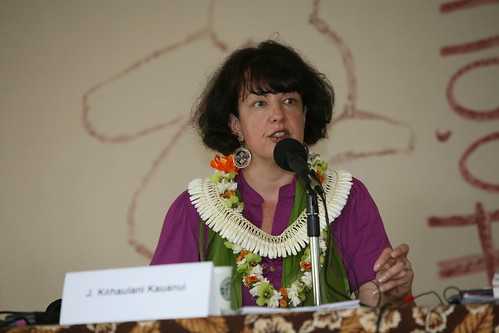 As the final speaker in the Ontologies of Exhumation lecture series, Native Hawaiian activist and scholar Dr. J. Kehualani Kauani, associate professor of American Studies and Anthropology at Wesleyan University, came to Columbia on April 21, 2011 for a session on Native Hawaiian indigenous politics surrounding the adverse effects of Hawaiian burial ground desecration in the form of architectural construction.
 ch began in 2007, Native Hawaiian protesters and activists were denied of their requests for a halt or temporary injunction to stop construction until a Burial Treatment Plan was approved (which wasn't until the 16th draft in March of 2010). Part of the issue was a lack of genealogical experts within the SHPD to trace familial lineages which were required by NAGRPA law in order to halt construction.


