Saturday, October 25, 2014

Timeless Spaces, Never Changing Places


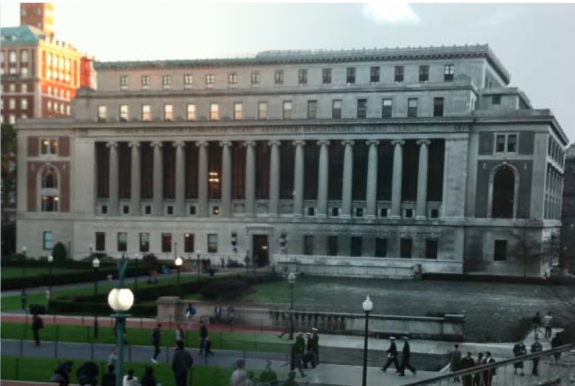
“Plus ca change, plus c’est la meme chose.The more things change, the more they stay the same.  This well-known epigram, written by Jean-Baptiste Alphonse Karr, was the first thing that came to mind when I stumbled upon this series of now and then photographs. These portraits of Columbia from Butler Library cast an interesting light on the notion of cultural continuity unique to this academic environment.  

The ghosts of Columbia students past dressed significantly better. The grass was slightly less groomed. Aside from these minor disparities, both sides of these images posit a scene current students readily identify with. About seventy years have elapsed between each side of the frame; yet, there is no overt clue – no telling – of this. There is no profound marker that so many days have gone by, so many students have come and gone, or that so much work has been done, books read, or conversations had. There is no physical testament to this history. There is no indication that this was past and this is present, nor evidence to suggest that Columbia in 2014 is drastically different from Columbia in 1944. Meanwhile between these stills, a lot has happened in this city and in the world. From World War II to Vietnam, Woodstock, man on the moon, JFK, test tube babies, the Internet, and 9/11 – time has passed. Things have changed. Well, at least some things.

Could certain behaviors and environments be timeless? How do we identify changes in time?  Butler library is a truly unique place both within the university and in general. Open twenty-four hours a day and seven days a week, it is a space that is constantly inhabited. People cycle in and out. They work there, socialize, often eat, and even occasionally sleep there. It is a place with many niches that are commonly associated with different types of disciplines and different types of people. The demographic of each room is unique and the duration of one’s stay is highly variable.

What makes the space truly interesting, however, is the way in which it alters senses of time. The “Butler Bubble” is a space in and of itself, replete with its own language and ethos of behavior. Time is measured in tasks accomplished or tasks left to accomplish. “How long are you going to be here tonight?” I asked one of my friends. He responded – as one usually does – by succinctly stating, “Until this [paper] is done.” 

Much like the life inside a windowless casino, the passing of time does not penetrate this great library. Rather than clocking hours, life inside Butler is “clocked” in terms of the completion of “to-do” lists. Perhaps this non-temporal practice is laden within the architecture itself. From the outside, the building appears to have numerous windows. Inside, however, this is not the case. Between the dimply-lit hallways and workspace areas void of natural light, visual access to the external world is broken. The stacks ensconce individuals in a world of only books. The study rooms hold a similar albeit warmer atmosphere. Even those rooms that do contain windows rarely have a view of anything other than the campus. There is neither cityscape nor pastoral landscape to gaze upon – only Columbia.


This sense of timelessness – and disconnection – is perpetuated by the feelings one has upon leaving the library. One typically enters in daylight and exits in darkness. As you push through one of the main entrance doors and feel that first gust of wind that sweeps across your face, you are awakened by a cacophony of sounds coming from students rushing from place to place, the Broadway traffic and other typical “street noises” that we have come to associate with living in New York. You’re not sure how long you’ve been in the library, although your stomach is usually letting you know that it’s been quite a while. You look around you, take a deep breath and stumble home, revising the “to-do” list in your head based upon your most recent accomplishments. On your journey home, you check your cell phone and your temporal setting returns. What time is my class tomorrow? How many hours of sleep am I going to get tonight? Until the next venture into Butler. Rinse. Repeat.

[Photos Taken from Columbia Blue and White, www.bwog.com]

By Gabby Borenstein

Wednesday, October 15, 2014

(Plant)ing Evidence: Archaeology in Dark Green

by Jeff Benjamin

October 15, 2014
Riverside Park, NYC (all pictures) 
Archaeology requires sustained attendance to form. This kind of disciplined attention has its challenges and rewards. The mystery of the process of observation is distilled in the zen koan: “A 
mountain is a mountain/ A mountain is not a mountain/ A mountain is a mountain.” This poem seems to suggest a path from illusion to doubt to understanding - a kind of maturation - whereby in the final 
stage we can hopefully retain some of the initial enchantment that caused us to begin to look in the first place. The question that has been occupying my mind lately has been: Where should I direct my gaze for the next few years? What should I study? There are practical considerations of course: geographical distance, available archival documentation, other authors' work in the subject. But then there's another side: How will this sustained scrutiny of exterior form affect my internal life?


Four years ago, I was asked by some friends in New York City to build a roof garden for them. At the
same time, I was pursuing a degree in industrial archaeology. Their request was timely. I had been 
thinking about the integration of industrial and ecological forms, the adaptive re-use of industrial 
sites as places of architectural and environmental synthesis, and since they lived in an old warehouse, I suggested that they install a green roof. I learned everything I could about water and root barriers, 
filtration, drainage substrates, growth medium and the plants themselves, and began the process of 
gaining approval from the building owners and enlisting green roof specialists and engineers. School 
took me away from the work, but my friends continued the project, and now there is another small 
patch of grasses, flowers, sedums and sempervivums on a roof in Manhattan. As soon as it was 
installed, there were non-human visitors: butterflies, bees, many other insects. It pleases me to no end to witness an expanding rooftop wildlife corridor in the city, an archipelago of life.


When examining and thinking about industrial and pre-industrial structures, we are often confronted
with this material known as “wood,” but I think a more accurate term would be deceased arboreal 
tissue. There is a biology within structure. Of course there are transient living beings, but there is also, embedded within this deceased arboreal tissue, a vast amount of information pertaining to environment, time, rhythm, tool-handedness, sound, fire, drought, soil characteristics, traffic, transportation, growth, harvesting techniques, all of which problematizes the distinction between artifact (an object made by humans) and ecofact (an object not made by humans but carrying cultural significance).

At the heart of these thoughts is the concept of cross-species identity. I identify with trees. Over the course of my life, having incorporated enough of their tissue into my lungs and fingers, it is time to offer something in return. This is all still in the realm of abstraction, but can perhaps be approached in a series of questions:

Can western red cedar separate poetry from philosophy? Is digital mutation familiar with redwood?
How does chlorophyll bear witness to genocide? Is a fluttering aspen leaf the genesis of rail 
transportation? How does maple organize human thought? Will the thrush return to the same elm?
Is amaryllis partial to Kropotkin? What does microscopy gain from balsam fir (and how does birch tag along)?


by Jeff Benjamin

Wednesday, October 8, 2014

‘It [the railway] transmutes a man from a traveler into a living parcel.’ 

- Ruskin, The Complete Works (qtd. on p. 54 in Railway Journey by Wolfgang Schivelbusch)

Delancey Street Station 8:30:00 
Delancey Street Station 8:30:05 p.m. 
Delancey Street Station 8:30:11 p.m. 
On any weekday, 5,465,034 people ride the New York City subway, boarding one of the 6,235 trains at one of the 468 stations in New York City[1]. New York’s subway system first opened in 1904. This innovation encouraged people to live and work in increasingly separate locales.

Today, the average New Yorker commutes 48 minutes to work, 13 minutes more than the national average[2]. In 2013, a report from the US Census Bureau found that 8.1 percent—or 10.8 million—of American workers commute more than an hour each way[3].

In this era of standardized time we are expected to coordinate our activities with others. To achieve this, we wear time-reckoning devices and carry phones equipped with GPS mapping devices to ensure we take the most efficient routes possible. For all of my awareness of time, I still feel “behind,” and as though I’m always rushing.

For example, even if I am early, if I see the C train approaching the station, I will run to catch it. I’m not alone—there are many others—panting and swinging their overstuffed tote bags as they run down the platform.

My question is, why? Will shaving three minutes from my commute have an impact on my day? Most often, the answer is no. But I can’t help but view time economically, as something that is to be spent wisely.

The act of commuting is a strain. It is monotonous and the worst part is that it is unavoidably time-consuming. 10.8 million Americans will spend 500 hours a year commuting—that is over 20 days per year.

Can a commute be fruitful or useful? Perhaps. Surely, it is not beautiful. Underground, there is no landscape to gaze upon. Sometimes, if you’re lucky, you can claim a spot on the front of the train and peer through the front window. But most often, there is nothing to look at all, except one’s reflection against the blackened window.

Under the ground, in the tunnels, the passage of time is unobservable through nature. There is no light. Enter at 125th Street in the late autumn afternoon sun, and you will emerge, disoriented, in total darkness downtown. 

Despite this, I know that time is passing as we move forward along the map. I envision the landscape I am traveling underneath. 

The people on board drive me crazy but they keep me sane: the performers, lovers, children, businessmen, baseball players. It is the movement of bodies on and off the train that reminds me that we are going places. I will say that there is something comforting in the movement of fellow-commuters, in being one of 5,465,034. 

Robert Fasanella - Subway Riders, 1950

Thursday, September 25, 2014

The Presence of Time


“Everything begins and ends in the ‘real’ world, but that is not ‘our’ world. ‘Our’ world is a shifting play of images, and maps that locate and generate these images” (Gell 1992:241)

In my sink there is an assemblage of artifacts, a present of traces or echoes of past presents and future pasts both habitual and indexical. There are retentions and reproductions, the former being traces of food the latter being the image of similar assemblages.  As an archaeologist of the present having just finished reading Alfred Gell’s The Anthropology of Time, how do I approach this assemblage and begin to understand temporality as something fundamentally real and avoid reducing it to the “human time” of phenomenological perspective?

There is real time within the series and frames, within the habit and boundaries of a shifting and stable assemblage. There is a location; this is my apartment in New York City. It is September 25, 2014 at 3:35 am (picture A), September 25, 2014 at 3:38 am (Picture B), September 25, 2014 at 4:07 am (Picture C).  The process of washing dishes was temporarily concluded on September 25, 2014 at 4:14 am (pictures D and E).  The assemblage only exists as an assemblage within these frames, but is exists.


Picture A
Picture B
Picture C

Picture D


Picture E


One of the most serious questions for contemporary archaeologists is that of temporality.  How do we do and what is an archaeology of the present, of the contemporaneous? Sitting though workshops, lectures, and presentations the one dilemma that every contemporary archaeologist is forced to address and wrestle with is that of a continuous present, both experientally and physically. This positioning within the present makes establishing boundaries, categories, frames of reference, and archaeological distance difficult.  One approach to the paradox that is contemporary archaeology is reducing it down to a phenomenological experience that is composed of the impressions and perspectives of the archaeologist (human time). This approach definitely has its uses, but typically only as a means of capturing a present state, a tensed state, that as it comes into being is rendered false an in need of revision.  The conundrum is that human time is how we experience and know the objective “real” time, and yet real time is always present in the frames we create and tokens we identify.

Monday, December 2, 2013

1, 2, 3 Smile!

According to the old legend the Romans had a code of conduct obliging the one who takes an oath to put his hand in the Bocca della Verità (Mouth of Truth) at the church of Saint Mary in Cosmedin. If they were not telling the truth the mouth would close and bite off the liars hand.

Firstness: The entity - http://en.wikipedia
.org/wiki/Bocca_della_Verità
The Bocca della Verità is at least 2200 years old and weighs about 1200 kilos. It is a Pavonazzetto marble disk depicting a head, where the eyes, nostrils and mouth are carved all the way through the 19 cm thick stone. According to studies, it probably represents the god Océanus. He is the source of all rivers, the entire sea, all springs and all deep wells according to Homer (Iliad 21. 194 ff). This is why most scholars presume it to be the original drain cover of the ancient temple of Jupiter or the temple of Hercules. The temple was built using a similar circular domed rotunda or vault roof construction as the Pantheon with an oculus, round open space, in the middle. That would also explain the 2 holes on the side of the stone, which could have been used for the horizontal fixing on a vaulted roof.After the demolition of the temple the Bocca della Verità was placed in the narthex or portico of the Santa Maria in Cosmedin church around 1650 where it stayed ever since and became known as a place to take the test of truth.
Secondness: The Relation - http://retroblogrome.com/
the-roman-trickery-of-bocca-della-verita/
To put this in perspective, the temple of Hercules is directly across the street from the Cosmedin church. In 1953, the general public was introduced to the Bocca della Verità in the Audrey Hepburn film, Roman Holiday. I won’t go into the significance and details of this scene. If you haven’t seen the movie yet, then you really should! It is a classic. It’s Audrey Hepburn. It is filmed in Rome.
Over Thanksgiving I break I traveled to Roma to visit my sister who is completing her study abroad semester. We did a lot of sight seeing and ate a lot of pizza and gelato. It was a fantastic week. Of course there are long lines to see the world famous ruins and art in Rome. We decided to go see the Mouth of Truth on a whim and didn’t think there would be a line. On the contrary there was a line extending out of the church. We waited and waited and when we got close enough we realized everyone was talking about Roman Holiday and imitating the scene in front of the Mouth.

Since the line was pretty long, I had a lot of time to think about Charles Sanders Peirce. I was thinking about the profound effect a popular film had on this artifact. All of these people were excited to imitate this scene and reproduce an iconic moment. Maybe it was the intense sugar high from all of the gelato but I started thinking in Peircean triads.
First we have the entity; the Mouth of Truth. Second, we it’s relation to the film. Third, we have fanatical representation of an image. Now the artifact embodies new meaning in relation to the film. According to Peirce “Now Thirdness is nothing but the character of an object which embodies Betweenness of Mediation in its simplest and most rudimentary form; and I use it as the name of that element of the phenomenon which is predominant wherever Mediation is predominant and which reaches its fullness in Representation” (Peirce 244).
The Thirdness depicted below is not the image itself, but the element of image that represents the Mediation of the Roman Holiday phenomenon. Moreover, there are certainly hundreds of these images taken everyday representing this same Thirdness. It is interesting to see how meaning of an entity can change given each new relation to new entities or new meanings. Peirce certainly discusses this phenomenon but I hadn't thought too much about it in archaeological tourism.
Thirdness: Representation

References:

Peirce, Charles S., and James Hoopes. Peirce on Signs: Writings on Semiotic. Chapel Hill: University of North Carolina, 1991. Print.


Post by Becky Fisher


Tuesday, November 26, 2013

The Hunt


We hiked north up the fireroad, an area (either man made or natural) that is broader than a normal foot trail and and is kept clear of deadwood and other combustibles. It was a crisp winter day and the path was dusted with falling snow. A light wind blew and Kota stopped dead in her tracks.  Seeing her do this I knew she had caught the scent of another animal.  I reacted to her by copying what she always does, taking in short breaths while moving my face slightly in different directions.  

From a simple biological perspective Kota’s sense of smell is much more honed than mine, but humans possess a remarkably broader range of sensory perception than most of us are aware. Throughout the twelve years of hiking and camping across the United States, Kota has helped me develop a sense of smell for signs present in those types of natural environments. For instance, it isn’t simply the ability to identify the presence and difference between carnivores and herbivores on the wind from the smell of urine and feces, I can smell changing weather, fire, moss (and hence dampness), vegetation shifts (identify old growth vs. new growth without seeing), and even the presence of dens or caves. Of all the senses smell is Kota’s strength, some animals are first signaled through sound, sight, or feeling, but that dog can retrace my daily movements by smelling the bottom of my shoes.  Mine is obviously sight, which is why her placing her nose in the air and breathing in short intervals signals to me to do the same.  

Returning to our hike, she stops and points her nose in the air signaling to me she has caught a smell.  I stop. We both take short breaths (like smelling wine) which helps to isolate and filter out all the smells in the wind. There are no words for the symphony of smells that include musk, moss, wet stone, cedar, sycamore, pine, dirt, and…something tangy, sweet, musky, and there is a presence of fur and dried grass. It is a deer.  Once the odor is identified, I close my eyes and breathe a little deeper. The touch of the wind on my face changes, and from the slight bursts and shifts I can identify a general direction from which the smell is originating. It is behind us; Lakota also signals and we both turn to scan the scene visually seeking what we know is there.  Within this cold windy environment my sight is much better than Lakota’s senses and I find the large buck quicker than she does.  Through experience, I know she needs there to be movement (audibly or visually) in order to identify the animal’s antlers from the trees. I on the other hand can see a face staring straight back at us from behind a few leafless trees approximately 12 feet west of our location.   


We had walked passed the deer before the wind brought the smell to us (upwind and downwind are very important directions and orientations), so it naturally smelled us first. It stood completely frozen, waiting for danger to pass.  There would be no surprise attack. I could see the scene play out in my head, and we honestly stood no chance in even coming close to the buck. However, one still has to try, who knows maybe the deer is injured or trips and we get lucky. I drop my pack and move as stealthily as possible circling the deer downwind.  Lakota sees me move and knows I have identified the animal before she has, so she moves with me, looking in the direction I position myself against.  Mimicking my movements and looking in the direction from which there is a reaction allows her to triangulate the position of the buck that she has yet to see. 

The snow crunches beneath my feet; I am clunky, loud, slow, and awkward. The deer reacts to this by the slightest movement and Lakota locks in on him. Her dependence on my signals cease immediately upon identification of the buck and she moves away from me in the opposite direction.  She jets strait and to the left, I sprint out and to the right, the deer turns in a third direction and bolts.  We both run after it from complimentary angles, but it quickly sprints uphill to safety. We all freeze, Lakota the last to stop running. I can tell she wants to continue the chase, but even she realizes it is a lost cause. I call her back and she returns to my side quickly, something that would not happen if there was still a chance in her mind.  Looks are exchanged, and we leave the deer behind us alert and watching, motionless.


All animals are capable of complex modes of communication, all with their own strengths and weaknesses. Perhaps I am a slow, clunky and awkward huntress, but through this type of play I have learned to pick up on various things of significance and meanings of which I was previously unaware even existed.  I would have never been able to physically catch the deer with my bare hands, but learning how to move as one has saved me and Lakota many times when we have been attacked in the dog park. We trust each other. Lakota is overwhelmed in some urban environments and as a result becomes a creature of habit in the city. She likes routines in the city, to a neurotic (and unnatural) degree.  She will only go to the bathroom at particular places, she will fight to avoid particular intersections and streets, and she becomes suddenly aware of the minute. Busy streets freak her out the most. After 12 years she still does not understand how streets, people, and cars move.  When crossing the street she does not see the signal placed specifically within the range of normal human standing height. She does not observe the icon of a palm facing us and blinking. What she sees are cars stop and I move us across the road. She has thus come to read a car stopping as time to go, only sometimes that is completely wrong and it is a taxi just pulling over.  This misreading might get her killed someday, but I am sure she thinks the same thing about my reactions to the deer.


There have been signals “engineered” for both of us.  There are wolf signs, dog signs, hunter signs, and hiker signs. I can only try to move like a wolf on a hunt, but I will only ever be a human in the woods. She can only ever be a dog in the city. I believe that can learn the carriers of meaning that Lakota picks up on, but what she smells and what I smell are undoubtedly different.  The smells are not the same, but the meaning is similar, “there is a deer present”.  Similarly, based on her perceptions of my reactions she believes the stopping car is a sign that it is safe to cross the street. This is not entirely incorrect, but it is a different sign with a different meaning within that environment. Just as she is wrong with her perception of my perception, could I also be wrong with what I perceive is hers?