Thursday, April 25, 2013

Museums in NYC: The Conflation of Time and Space


New York City is full of museums of every type. From the Guggenheim to Madame Tussaud's Museum of Wax a tourist or resident New York can see almost any subject on display from any time period. This is the uniqueness of museums in that they transport objects and exhibits from a infinite number of spaces and times to one location in the present. As archaeologists we study whats left of the past in the present and how those traces are defined in our own cultural context. Perhaps their is no better place for this endeavor then a museum. In a single exhibit, thousands of  objects from different cultural backgrounds, places in time and societal backgrounds are placed next to each other based on arbitrary decisions such as geographic area and place in a Western linear timescale. A person need no longer travel to Egypt with its searing hot deserts or to the fog shrouded mountains of Peru. They can simply hop on the A train or drive to Brooklyn and see objects that seem to transport them in a mimetic way. This act itself changes the definition of the object into a different subject. We no longer see these artifacts as they were seen in their creation, and if Gell is right we can't and the power of objects is not really real. However, museums attempt to transcend this claim through the display of diverse objects, and though we are separated by glass, or the guards who yell "don't touch!". The quiet and awe with which we view and reach these artifacts gives them an all new kind of power.

Temple of Dendur at the Metropolitan Museum of Art

Perhaps the best example of a museum condensing time and space is the Egyptian exhibit at the Metropolitan Museum of Art, especially the incredible Temple of Dendur. Which was transported brick by brick to the United States as a gift from the government of Egypt in recognition of American assistance in saving sites from inundation after the construction of the Aswan Dam. For New Yorkers and Americans the chance was suddenly their to see an Egyptian temples, thousands of years old, in New York. A trip to Egypt itself was no longer required. However, this simply act drastically changed the perception of the temples time. The surrounding exhibit houses thousands of objects from different historical periods of ancient Egypt and the result is sense of time is lost. One stone axe is from the pre-dynastic period and sits next to a stelae of hieroglyphics from the third dynasty. Almost a thousands years separates the two objects. However, to the casual  observer they are both simply ancient, from a culture that disappeared long ago. No thought is given to the cultural and societal differences that may have changed over that thousand years. The Temple itself is good example. Most visitors assume that it is a Pharaonic temple, when in fact it was built by the Roman Emperor Augustus, three and a half centuries since a native king ruled Egypt. But unless ones does the research, the temple remains part of the modern perception of Ancient Egypt, not of its role in the Roman Empire, two contexts seen as separated.


African Exhibit at American Museum of Natural History
T-Rex at American Museum of Natural History

Museums also attempt to conflate space. Exhibits are designed to give the viewer a sense of what it must have been like in the environment that the mural is supposed to belong too. At the American Museum of Natural History the exhibits of animals of Africa are given poises in panoramas of tall grass and lush oases in the harsh Serengeti. Like Trains and railways in Schivelbuschs book, space is instantaneously trasported to the viewer without a sense of actually traveling their. In addition that space is constructed, to appear to what a New Yorker or American would think the African savanna would look like. In the case of the dinosaur exhibit, pictures of a lush landscape are replaced by stark white walls and modern styles of internal architecture. This is because we cannot fathom what the environment of the dinosaurs must have been like so many millions of years ago. Instead the fossils of these long dead behemoths take on a timeless, mythical quality. The architecture and cultural understanding of dinosaurs reinforces the notion that these animals were from a place that time forgot, outside our own conception of the past.

Colonnade at the garden of the Cloister museum. Every column has pieces that original and those that are fake.
Tombs at Cloisters Museum
If a person wants to visit Medieval Europe, one needs simply get on the A train and take it all the way to Washington heights on Manhattan island. emerging from the subway, the traveler is greeted with the sight of a Medieval monastery on a high hill overlooking a steadily flowing river. However, unlike the temple of Dendur, this monastery was not transported from Europe but rather built by American architects in the twentieth century, along the lines of what they believed a medieval monastery would look like. The museum is filled with objects d'art from medieval France, Germany and England. For an archaeologist this presents the perfect opportunity to examine the past in the present. No artifact has been untouched. Many bear the unmistakable signs of wear and tears from centuries of study, veneration and simple movement. They are grouped according to style, common subject, and century. However, many come from vastly different contexts and were shaped by events that were separated by many years. Many, such as the columns that enclose a medieval courtyard, complete with plants of the middle ages, are joined with pieces from the present day. The famous tombs of several different knights, ladies and nobles bear the marks of being constantly touched and moved. To the viewer this is like a thousand different time periods and peoples coming together, preserved in the marks. The tombs themselves are of people who never met in life and yet now share a relationship in our contemporary mind as people who lived in the Middle Ages, the proverbial "back then."

All of this presents a fascinating picture to the viewer. Different artistic styles, from different times come together in one conglomeration that seems smooth in its presentation. If anything it invites closer participation. For a viewer to see the differences between each object, they must not simply evaluate each object side by side, but rather the captions beside them. To read the dates given and the little blurbs about the historical and contextual background. However, this adds to the complexity of the museum. Each object has caption and one must rad thousands of words along with viewing the thousand of objects. The result is that most people gloss over and retain the definition of the distance between the viewer and the object. The museum then produces a conglomeration of multiple time scales and physical spaces and condenses them into one viable, summary that itself is defined by the museum and those who curate it. It is another process by which the past is produced through material remains in the present.

Museums are fascinating places and the people who curate them work hard at using artifacts and exhibits to educate the populace about history and art. For the archaeologist they provide a wealth of other other experiences. We can see many traces of several different pasts, several different ways of keeping time joined side by side in a visual context. We can see how artifacts are redefined by us in ways the original uses, or users, never would have imagined. For instance in the Metropolitan Museum of art, their is the main Egyptian exhibit, but in a unrelated exhibit their is collection of Byzantine Egyptian art. What is the difference between the two? Who decides where antiquity ended and the Byzantine period began? Museums provide a excellent place for archaeologists to ask and work towards answering these questions about the human perception of time and place, especially when they are all brought together in one room. As well as the inherent problems they present.

By Matthew Previto


Suggested Reading
Gavin, Lucas
   2005  The Archaeology of Time. London: Routledge.
Gell, Alfred
   1992 The Anthropology of Time: Cultural Constructions of Temporal Maps and Images. Oxford:
            Berg.

Olivier, Laurent
    2012  The Dark Abyss of Time. 

Schivelbusch, Wolfgang
    1986 The Railway Journey: The Industrialization and Perception of Time and Space. Berkley: The                  
             University of California Press.
Shanks, Michael.
    2012  The Archaeological Imagination. Walnut Creek: Left Coast Press.


Wednesday, April 24, 2013

Time as a construct in one's mind


My experience of aging serves as a poignant example of varied experiences in time.  Although my physical body continues to “decline”, my perception of myself in time is hardly uniform, nor is experienced in a linear manner.  Not looking ones age is cosmetic and appreciated, but not feeling one’s age is immediate and bizarre.
I’m at the gym and lifting weights; all of a sudden I notice the tide like character of the wrinkles on my arms; tide like because they appear as ascending waves.  There is actually a reaction, “this can’t be my arm”. There is a startling quality that comes with it; a refusal to recognize that one’s body is actually deteriorating as appropriate with its calendar age.  Although this may be unconsciously connected with issues of mortality, mainly it resonates as a brutal break in an awareness of actual time.
              The psychological clock of mine is often not consonant with the “real” time.  Perhaps that is part of the offense that occurs for me when someone jumps up to offer me a seat on the bus; I feel they don’t know who I am, that they mistake my looks for someone older.  Aging puts you into categories, categories that are elastic in one’s own mind, but are fixed to onlookers.
Starting graduate school I have always been somewhat uncomfortable the first day of classes, anticipating my classmate’s and professors reaction to me.  What do they imagine about this old lady in their midst.  Speaking of categories, I don’t belong in the classroom; I don’t fit the profile of student because of differences in time.  As a prescription and regulatory practice, college is the time for youth.  Times apparently have their own assumptions; they enforce stereotypes of who belongs and who doesn’t.  In this way I have jumped out of categories, and in doing so have entered into a space where my belonging is at question.
All these assumptions and categories are haunting when one assumes the present can still be about the past.  Memories are different as I grow older.  They are less connected to interpersonal events and more related to what Yannis Hamilakis calls multi-sense traces of events.  For example, the tiny images of leaves forming again on the trees in the spring evokes for me a particular experience of standing in my living room while I still lived in Chicago, some 40 years ago, and looking out the window at the sight of the new unfolding leaves on the trees forming a spider web of light and shadow as I was waiting for the committee I was chairing to arrive.  The image is fresh in my mind although particularly clear recently.
            Shanks writes, “the footprint or vestige is not like a trace….it will haunt when it is found in the future and then witness the passing over of what is no more”.  I think the haunting is responsible for my breaks in the present; the compilation of my experiences over a life time still exist and remain alive until shaken by the reality of the present.    As the past interrupts my present, my present also interrupts my past and perhaps threatens to cancel that past in the constant move towards the future.   In such a way I waver between my present, and the footprints of my past. 
Shank continues in a later passage, “Setting the present in opposition to the past, as times or tenses invokes the corresponding contradictory temporal states:  the past that still has an effect on the present.”  This, then, is a way of keeping the remains of one’s life alive.  

Thursday, March 28, 2013

Time for Spring Break!

Time for Spring Break!

Like so many other students, I chose to flee the cold late-winter days in the northeast in order to find some warmth and some sun in the Bahamas.  Unlike so many others on the plane with me though, I was there for a job interview -- not just a vacation!  Mixing business and pleasure certainly is a wonderful experience and I would recommend it to all.

Leaving Newark International just after dawn meant arriving at the airport at times of day best reserved for the imagination and though Sunday mornings at 3am seem like a great time to travel around the empty streets of Manhattan, as it turns out that's a time too early even for many of the public transportation options to function.  Arriving in Penn Station before the gates were open and at the Newark International train stop before they had the AirTran running meant standing around with other eager and anxious travelers and constantly checking our watches (read: phones!) to see if we were "on time."  Over the course of my trip I experienced at least four separately identifiable paces of ɶcological time and decided to take on the role of observer in order to try and decipher the patterns of each.

Sunday, Pre-Dawn, Manhattan, Vacationer Time:


Empty subway stations and trains, long waits between one train and the next, unoccupied station offices, an eerie quiet throughout until the subway cars whistle by.  Without express options the train doors open at each and every stop along the route and because of nighttime and weekend work hours for the mole-people construction crews, the pace is slow and steady.  There are four other people in the center car with me with a similar smattering throughout the 10-car behemoth rolling down the tracks.  One is asleep, two and three -- an apparent couple -- seem to be returning from a night out and totally engrossed in themselves, and four -- seemingly another traveler given the size of his suitcase -- makes eye contact with me and smiles knowingly at my bags, thinking the same thing I am "it will be nice to get away for a few days."  Moving down the tracks from station to station and having the doors open onto empty platforms along the way my mind begins to wander and I think about how different this trip on the #1 is different than any other time of day or week.  I glance at my phone to check the time and recalculate to make sure I will make it to Newark International early enough that I won't have to rush.  Music plays in my headphones and I look around the other faces sharing this quiet moment with me.  When we get to my stop -- 34th St / Penn Station -- I load up my bags and head to my train, my fellow traveler in tow.  At this point we are comrades and though we haven't spoken a word to one another, people around us may see us as friends.

Finding the gates to the trains locked because it is too early is a novel experience in New York.  Rarely, in the "city that never sleeps" is the time on the clock or the time by the sun seen as a reason to disrupt the normal flow.  Here though, we join the throng of other travelers who have taken up position before the gates and slowly pace in front of the security officers, silently willing them to let us in just a minute or two early.  The buzz of this waiting area brings us all back to our "New York Minute" mindsets and people jockey to be first in line and a step ahead of those around them.  The more people you are surrounded by, apparently, the more you want to be first in line.  It is certainly true that there are those who naturally buck this trend but for the masses, the mass mentality takes over and even though the train will not leave any sooner if I am on it first I must admit to having a noticeable desire to get through gates closed off to me by the clock.  If a door is locked to access then I am content but if it is locked only intermittently then I find myself wanting to get through it.  Having timed this trip in such a way that hours matter but seconds don't there is no reason for me to care that I get on the train first ... but I care nonetheless!

We are on the train and soon at the airport stop.  The AirTran, which normally runs every 4 minutes, is not open yet and we need to wait for a bus.  Again, because the normal pace we are all used to is not available we are antsy -- it is not because we need those seconds and minutes but rather because they would be available in an hour and so we want them now.  As the morning begins to color the surrounding sky and the number of people I am surrounded by grows, the pace of life and propensity for people to check their watches and phones to see minutes ticking by grows.

Airport Time:


Newark International with a sunrise over Manhattan


Whether at Newark International before dawn on a Sunday, Nassau Airport at noon during Spring Break week, or Rock Sound Airport at any time, "airport time" seems to be a thing consistent to most travelers in most airports.  Like a casino the job of the airport is to separate travelers from the outside world with high security, formulaic procedures to get from point A to point B, and people everywhere wearing costumes to designate their level of authority of assistance-potential.  Unlike casinos though, airports have clocks EVERYWHERE!!!  Time is counted and displayed on almost any surface large enough to show the dials or digits.  It may ebb and flow in a way that would make a scientist go into apoplexy -- with delays and early arrivals -- but it is apparent to everyone that they should be somewhere at somewhen.  Like a good traveler, I arrived at the airport for my international flight about two and one-half hours prior to the scheduled departure.  And like a good traveler I got annoyed at those who had not given themselves enough lead time and were ushered to the front of every line because they were "late."  Turning to my fellow travelers as we got passed by time and again, I say "it sort of makes you wonder why you should be on time!"  Scattered grumbles and chuckles are evidence of the pre-travel annoyance that we all share ... we want to be on vacation already but we keep getting reminded that we are on clock time for a while longer.

Nassau Airport at rush hour!

Lines are long but move quickly, an efficient beast slowly yawning to life as a new day of departures and arrivals greets the small city that is Newark International.  Beyond the sterility of the ticket counter and the security line (perhaps "sterile" is the wrong word given everyone walking around with no shoes!) the promise of stores and food stalls and endless opportunities to spend more money await.  The hustle and bustle of those who rush to their gate and the impatient foot-tapping of those who want their row number to be called.  Whether I was going or coming this was the same feeling at every airport.  Surprising though was the fact that there was no difference between Newark International with three terminals and thousands of people, and Rock Sound Airport with only about twenty people and one plane.  Regardless of where you are, when people are at an airport they are focused on the clock and they are impatient because of the feeling of "wasting time."

Island Time:


A meditative bench overlooking the ocean

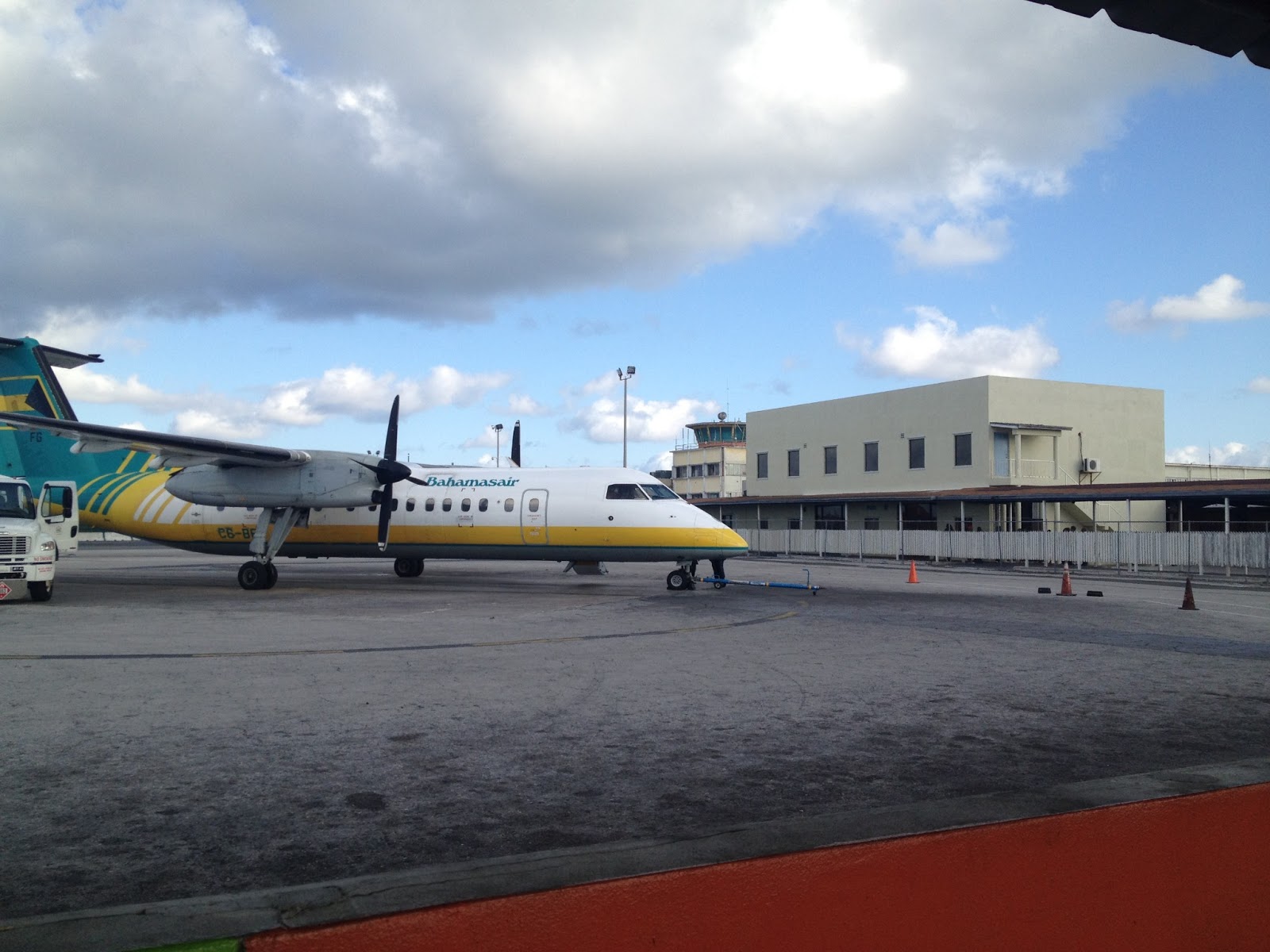
Arriving at Rock Sound Airport I am immediately inundated by island time.  The opposite of hustle and bustle, I gather my bags and step outside to see folks milling about and awaiting rides that had been scheduled but had not yet arrived.  Myself, I was expecting a pickup from the school at which I was to interview and expected them to be there when my plane landed (especially considering that the plane landed about 30 minutes later than scheduled).  Without a contact number or way of traveling the sixty kilometers to my final destination, there was little I could do but wait.  Striking up conversation with the baggage handlers who found themselves on break between flights and sharing the dried mangoes I had brought with me from New York, I found myself relaxing into the space and soon took off my bags and relaxed.  The stress of travel and the impending interview oozed out of my body and I felt myself grow calm and serene -- more than that though, I could see the same feeling in those around me everywhere I looked.  It didn't matter if they were transient vacationers or locals, everyone I saw was calm and relaxed and moving slower here in Eleuthera.  I did not even see a watch on anyone's wrist (though to say that I never saw a person check their phone would be stretching the truth a bit).

Casting for dinner on the beach
Sunrise over Eleuthera Island
My ride arrived two hours later and rather than being annoyed by the delay, I was overjoyed at the time I had had to make some new friends and relax into this new place.  Like my times in Bulgaria, Bhutan, Australia, or South Africa, the prevailing feeling seemed to be that schedules and plans were more akin to guidelines and were never considered hard and fast.  This was particularly interesting to see in operation at the school I was visiting because at school schedules matter.  Though that was true (there was a time to be eating, a time for class, a time to swim with sharks and dolphins and sea turtles, etc.), it was also true that things blended together much more freely than they do here in Manhattan and that when someone tells you to meet at 1:15 they mean "sometime before 2" rather than "1:14."  Fewer people seems to mean less strict adherence to clock time and more general acceptance of what the world is telling you.  Perhaps, also, the heat and propensity to be outside makes it easier to schedule your day by the sun and the stars than by clocks hanging on walls -- which can only be seen while inside?

Thursday, rush-hour, Manhattan, Post-Vacation Time:

Transit Police keep order in a busy Penn Station
On the way home I spend time transitioning away from "Island Time" and through "Airport Time," hoping to hit my stride once I get back to Manhattan and find myself on the final leg home.  I have planned the trip poorly though and I get to Penn Station just as every other person on the planet arrives there (seemingly!) and the shock to my system is palpable.  Leaving Newark International to head towards the city was fine and normal because I was on "Airport Time" and had been for the entire travel day -- no disruption there.  When I stepped off the AirTran though and saw the train to Manhattan just pulling out of the station as I approached, I silently cursed myself for not having rushed just a few seconds earlier and "made the train."  A fellow traveler behind me actually cursed out loud at seeing it pull away and rushed down the length of the platform hoping he could either catch-up or, perhaps, convince the conductor to stop just for him.  I checked my phone to see the time, paced up and down the platform, and stubbornly refused to change out of my beach sandals even though the temperature was almost fifty degrees colder than it had been mere hours ago.  I wanted to remember the island experience and keeping those sandals on helped me get back to "Island Time" just a little bit and take a deep breath.

Huge crowds jockey for space and check the departure boards

Walking off the train in Penn Station though, it was impossible for me to maintain any semblance of "Island Time" as I would have never made it from the platform to the subway.  With what seemed like millions of people in the same small room all going opposite directions I had to put my head down and just walk.  Ignore the fact that I'm bumping into people and heading the wrong direction, I just need to look like I'm not a tourist.  Sure I got lost and walked the entirety of the station more times than I needed to, what mattered was that I was moving and moving with intentionality!  By the time I got to the subway I was fully back into my "Commuter Time" mode and avoided eye contact with fellow travelers.  Looking around everyone is staring straight ahead, standing and packed tight into the cattle-car that is the rush hour subway, plugged into private electronic entertainment, and resigned to the pace and comfort of their commute.  My bags were huge and awkward in the space but rather than apologizing I just had to close off and shut down like everyone else.

One more, Post-Vacationer Time:

I arrived back in my apartment exhausted from the trip (Newark International to Manhattan was much more trying than Eleuthera to Newark!) and literally fell on my bed with my backpack still on to wake up five hours later in the middle of the night.  I'm not sure if that counts as a sense of time or not but for those five hours I was separate from any time at all and though the lines in my face and sore back evidenced the passage of some clock time, I was certainly not aware of it!

Transitions between various ɶcological times are tough, especially when couched in the language of "vacation" or "commute" and though we often find ourselves moving at the pace of those around us -- even when we want to be moving faster or slower! -- I think my travels have shown me it is the transitions between that are uncomfortable more than the different time senses themselves.

- James Eberhart

Wednesday, March 6, 2013

New York Travel Time


New York City is most interesting on an ordinary day.  Although one could argue that in a city of 8 million people there is no such thing as an ordinary day. Aside from that most would agree on the definition of an ordinary day as scheduled habitual routine in an absence of special events. What is interesting about an ordinary day is the way the average resident of New York City perceives time, and if there are different temporalities within the ordinary day.  Does this person experience time particular to their environment, and does the shape of that environment change the way they perceive time? Do residents of New York experience temporality at a faster rate, as the saying describes, does a “New York Minute” mean that NY residents actually perceive time faster relative to others? Do we internalize ecological time reckoning (as Gell outlines from Evans-Pritchard's terms in Chapter 2 of The Anthropology of Time) (1992), or do we have our own individual temporal perceptions?

In an ordinary day, the New Yorker invariably travels somewhere, whether it’s walking across Manhattan, taking the subway from one borough to another, riding the crosstown bus, riding a bicycle to Prospect Park, or hailing a cab in the East Village. New Yorkers are bound up in an identity of constantly moving from place to place and getting there fast. City dwellers are considered fast walkers who can point out the tourists by their slow gait.  Bicyclists are considered brave souls for competing with the rush of city traffic. The subway lines and yellow cabs are as indexical of New York as the Statue of Liberty.  In a given ordinary day these transport technologies can contribute or detract from the success of an outing. It’s possible that our notions of time are influenced by our practices and forms of engagement with people and things in the world.


Traveling from place to place becomes a kind of art form, in which a person navigates while juggling their coffee, metrocard, smart phone, gym bag, book bag, grocery bag, or parcel while dodging people running behind them on the stairs or preventing them from getting off at the subway stop. People moving with, against, and through one another are each motivated by different agendas.  This constant activity animates the city with 8 million people moving in every possible direction, contained in an area of 300 square miles. Notions of time become fragmented by a sea of individual motivations of getting somewhere, which are continually called to order by the universal temporality and the organized modes of travel.

It’s as if we are grappling with a temporality that is grounded in our experience with the world but continually interrupted by the preoccupations within each of our minds, constantly streaming with information, making decisions, losing focus, coming into focus, and returning from absorption to reconcile with collective representations of time. Does our western gaze prevent us from seeing the metaphysical splintering of temporalities that are heightened by the way people move through space time? Does the mind begin to anticipate upcoming events or relive memories during times like travel due to a lack of activity in the moment? And though we are speculating on these moments of the future or the past, are we only seeing them in our periphery so to speak?

The city can be like an obstacle course, one can freely move, but the places we move and the speeds we move at are constricted by the city plan, other people, tunnels, pathways, and structures.  Where the motion begins to feel like it is determined by a force more powerful than one’s individual will, and other times the force of movement acts against human determination, pushing one further from the desired place at the desired time. This force can be traced to our own resistance to time, the rush against time. To make it stop, slow down or speed up is something we perceive to be possible in particular moments.

Is time different when we travel?  It certainly feels different, but is our time changing shape or behavior within the liminal time of traveling between places? As Gell would argue, there is no difference between cyclical and linear time; time is not repeating, alternating, or reversing (Gell 1992), but I would say it becomes stressed, compressed, slowed, or quickened. A constricted environment like New York is radically different from nature. But substantive universal time operates the same in either location. New York transit seems to operate within a system that organizes, assembles and funnels people by common destination, while our individual perception of temporality could be dictated by our divergent interests. If we oscillating between two temporalities, it seems arbitrary to pick out one activity like traveling or ritual to circumscribe the other temporality.

The city grid form guides people and vehicles through points of convergence and then reroutes them along the grid to accommodate a constant flow of people. It seems that a tension does develop between ordered uniformity of socially imposed systems of time and the internal time of individuals.  Perhaps an effect of moving people who have a range of different internal temporalities through a uniform system results in successful enculturation of a pan-New York temporality.

In this system we are literally stacked in multi-storied buildings, and funneled through tunnels and gridded streets with building which cut us off from the sun and sky. The temporal order is bound up in the mechanical clock time that dictates public transportation. Our encounter with the natural temporal order of the day is significantly reduced by traveling underground and building up into the skyscape. This could be a fair representation of New York ecological time. Or perhaps people are transporting their minds elsewhere while their bodies travel along the municipal geometric design.  

What would make the temporal experience of New York City any different from any other major city of western modernity? Is it the impatience of residents who work against the universal time by speeding up? Are there multiple temporalities for individuals? Is travel time or mode of travel acting on the perception of time? We exist in physical isolation from the “natural” temporal order of the sun and stars, and we also invent ways to further isolate ourselves from each other by traveling with “devices” which draw us in to “doing” rather than contemplating. Is the New York cabbie using his car horn as an effective form of communication or is he aligning everyone to his temporality by honking? The car horn honks to grab our attention to the yellow cabs in the moment he decides that you are not moving at the proper pace. A soft bell dings to alert you to the opening of the subway door. Just like the Cathedral Clock, these are temporal snaps, abruptly aligning present company into the same moment.

by Lindsey Bishop


Gell, Alfred
 1992 The Anthropology of Time: Cultural Constructions of Temporal Maps and Images. Explorations in Anthropology. Oxford ; Providence: Berg.

Images:
Semonov,  Sergey. “Amateur Built Environment 1.”  Aerial Stitched Photo of Manhattan The Atlantic 9 Jan 2013 http://www.theatlantic.com/technology/archive/2013/01/the-best-aerial-image-of-new-york-city-youll-ever-see/267018/

“Wole Parks stars as Manny in Columbia Pictures' Premium Rush (2012).” Wole Parks riding bicycle Ace Show Biz http://www.aceshowbiz.com/still/00005988/premium-rush-image01.html

Wednesday, February 20, 2013

Butler Library through time


Butler Library
Butler Library is the largest of the more than twenty libraries and collections comprising Columbia University Libraries. It has an important number of reading rooms, while the heart of it lies in the stacks consisting in 15 independent floors of nearly 2 million books. It was opened in 1934 as the "South Hall", being renamed in 1946 in honour of Nicholas Murray Butler, president of the University from 1902-1945.

This library is a fantastic place to ramble through idea of passage of time throughout its different spaces. It is a center that remains open every day of the year and 24 hours a day. It is said there is a real Butler Culture, where students tend to stick to their own preferred reading rooms, and entire social networks develop around these after some time. It is also said that during midterms and finals some students virtually camp out in the library, leaving their belongings there.

Butler library is in fact a place where people spend hours and days, picking out favourite places to read or work with their laptops. It implies for many of them passing a number of hours in one single space, certainly experiencing diverse notions of the passage of time. It is quite remarkable that even though it is essentially a quiet space, it is full of motion. People travel in and out, sit in their usual space according to availability, go to the restroom, sit again, unplug the laptop, pack everything, walk and leave by opening the heavy entrance door as a true threshold to the exterior world.

Butler Library reading room.
The library is a whole world by itself, with different environments in which the passage of time is experienced in different ways. For instance, the reading rooms are usually open places with windows, surrounded by bookshelves, shared reading tables and individual reading cubicles, in which there is usually a fair amount of people. Spending several hours in these reading rooms allow perceiving difference in light and shadows from the outside that mark the day’s course. It is a quiet area in which every individual constitute a separate cognitive and experiential unit with little amount of interaction. However, it is possible to notice an intensive dynamic of activity and flowing bodies through space that essentially represents each one’s occupation and particular duties (governed by time).

The Stacks
The stacks are a completely different dimension in which there is no connection with the outside world, and where time passes with no other external reference but the clock. Its 15 levels are mainly filled with dark bookshelves, and a reading station with a shared long table usually in each level. The sensation of time here is given by its hermetic environment, and a distinctive old book smell. In an article from The New York Times Ben Ratliff elaborates an experiential description from this environment: “You hold the books in your hand and feel the weight and size; the typography and the paper talk to you about time. A lot of libraries smell nice, but the smell of the Butler stacks is a song of organic matter… A fantastic, pre-acidic-paper smell: burned caramel, basically. Nobody there but you” (Ratliff 2012).
  
Marks on main door.
Time has passed and is passing in Butler library, which is expressed through movements of its occupants. Even though some spaces seem sometimes in an abandoned or hermetic state, if determined by minutes or hours, they sure possess a constancy of movement in terms of days, weeks and days. This motion can be most easily observed by patterns of marks and wearing were the flow is intensified. This can be seen right from the beginning in the entrance door. People grab the right side of the door from the outside and inside, leaving a clear area free of bronze oxide from the constant rubbing of hands that polish the surface. Other marks can be seen in the entrance of restrooms.
  
Slight indentation on black marble stairs.
Detailed view of wear on the edge of black marble steps.
It is curious to notice that in the staircases where people are not usually seen, you can find the most definite trace of movement. This is expressed through a slight indentation in the black marble steps near the rail, getting even closer to the rail when the stairs turn the opposite way toward the next segment. This indentation caused by this constant movement of people, evokes the passage of thousands of steps walking up and down, dragging slightly their shoes and rubbing the black marble steps in a clear motion pattern. Small particles of dust or sand trapped in the shoe grooves act as effective abrasive agents in a constant flow through days, years and decades.

This leads us to different scales of time, in which the immediacy of seconds, minutes and hours, may not reflect long scale movements through time. On the other hand, the immediacy of identifying these long term patterns allows us to recreate an image of this long term passage and perceive oneself as part of this recreation. Suddenly the image arises of breathing bodies moving through the library’s different spaces, dragging their shoes or rubbing their hands in particular areas, creating marks that hold silent testimony of this dynamic through time.


Sources:


Ratliff, Ben
“Grazing in the Stacks of Academe”. The New York Times. Published: June 26, 2012. Retrieved from the web on February 19, 2013. http://www.nytimes.com/2012/06/27/arts/butler-library-at-columbia-is-a-haven-for-body-and-mind.html?_r=0&adxnnl=1&adxnnlx=1361372605-qmjNp7Oc81M/pca4WxyL9w

“About Butler Library”. Retrieved from the web on February 19, 2013. http://library.columbia.edu/indiv/butler/about.html

“Butler Library - WikiCU, the Columbia University wiki encyclopedia”. Retrieved from the web on February 19, 2013. http://www.wikicu.com/Butler_Library#Photos