
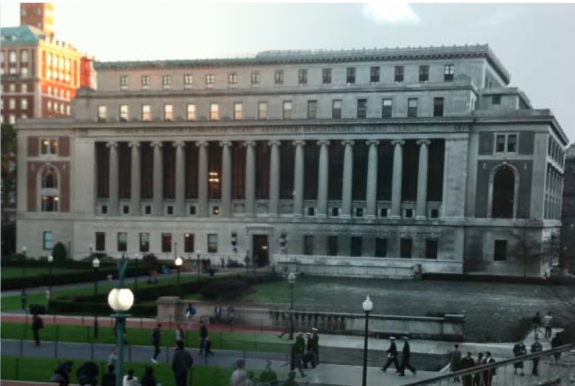

“Plus ca change, plus c’est la meme chose.” The more things change, the more they stay the same. This well-known epigram, written by Jean-Baptiste Alphonse Karr, was the first thing that came to mind when I stumbled upon this series of now and then photographs. These portraits of Columbia from Butler Library cast an interesting light on the notion of cultural continuity unique to this academic environment.
The ghosts of
Columbia students past dressed significantly better. The grass was slightly
less groomed. Aside from these minor disparities, both sides of these images posit
a scene current students readily identify with. About seventy years have
elapsed between each side of the frame; yet, there is no overt clue – no telling
– of this. There is no profound marker that so many days have gone by, so many
students have come and gone, or that so much work has been done, books read, or
conversations had. There is no physical testament to this history. There is no indication
that this was past and this is present, nor evidence to suggest that Columbia
in 2014 is drastically different from Columbia in 1944. Meanwhile between these
stills, a lot has happened in this city and in the world. From World War II to
Vietnam, Woodstock, man on the moon, JFK, test tube babies, the Internet, and
9/11 – time has passed. Things have changed. Well, at least some things.
Could certain
behaviors and environments be timeless? How do we identify changes in time? Butler library is a truly unique place both
within the university and in general. Open twenty-four hours a day and seven
days a week, it is a space that is constantly inhabited. People cycle in and out.
They work there, socialize, often eat, and even occasionally sleep there. It is
a place with many niches that are commonly associated with different types of
disciplines and different types of people. The demographic of each room is
unique and the duration of one’s stay is highly variable.
What makes the
space truly interesting, however, is the way in which it alters senses of time.
The “Butler Bubble” is a space in and of itself, replete with its own language
and ethos of behavior. Time is measured in tasks accomplished or tasks left to
accomplish. “How long are you going to be here tonight?” I asked one of my
friends. He responded – as one usually does – by succinctly stating, “Until
this [paper] is done.”
Much like the
life inside a windowless casino, the passing of time does not penetrate this
great library. Rather than clocking hours, life inside Butler is “clocked” in
terms of the completion of “to-do” lists. Perhaps this non-temporal practice is
laden within the architecture itself. From the outside, the building appears to
have numerous windows. Inside, however, this is not the case. Between the
dimply-lit hallways and workspace areas void of natural light, visual access to
the external world is broken. The stacks ensconce individuals in a world of
only books. The study rooms hold a similar albeit warmer atmosphere. Even those
rooms that do contain windows rarely have a view of anything other than the
campus. There is neither cityscape nor pastoral landscape to gaze upon – only Columbia.
This sense of
timelessness – and disconnection – is perpetuated by the feelings one has upon
leaving the library. One typically enters in daylight and exits in darkness. As
you push through one of the main entrance doors and feel that first gust of
wind that sweeps across your face, you are awakened by a cacophony of sounds
coming from students rushing from place to place, the Broadway traffic and
other typical “street noises” that we have come to associate with living in New
York. You’re not sure how long you’ve been in the library, although your
stomach is usually letting you know that it’s been quite a while. You look
around you, take a deep breath and stumble home, revising the “to-do” list in
your head based upon your most recent accomplishments. On your journey home,
you check your cell phone and your temporal setting returns. What time is my
class tomorrow? How many hours of sleep am I going to get tonight? Until the
next venture into Butler. Rinse. Repeat.
[Photos Taken from Columbia Blue and White, www.bwog.com]
By Gabby Borenstein
[Photos Taken from Columbia Blue and White, www.bwog.com]
By Gabby Borenstein


.JPG)
.JPG)
.JPG)


