Wednesday, February 8, 2012

I’m Not Licking Anything! ~or~ Columbia through Four of the Five Senses

I started this blog post by asking myself: if I were to write about Columbia University as a landscape, how would I do it? What would I say about it? As someone who traverses the uneven brick walkways every day, how would I describe it? And by extension, how could I describe it to someone who does not spend most of his or her time here? How could I explain to them the Columbia that I experience on a daily basis?

In previous posts, we have looked at Columbia through the lens of objective outsiders, or we have looked at one piece of it as one might examine a bug under a glass. But one thing that I think we have forgotten about Columbia as a place is exactly that. It is a place. Moreover, it is our place. It is, in many ways, the one thing that all of us have in common. To echo an idea that has been bandied about in discussion, Columbia University is the 4x1 city-block arena upon which all the little dramas of our lives play out.
As a place and a landscape, however, Columbia is very often neglected, unappreciated, and straight up ignored by many of its most frequent visitors: its inhabitants. Can any of us honestly say that we have taken time since ourinitial visits to really look at the campus we beat our feet upon? Do any of us ever stop and appreciate it in a Hoskins-ian sense? I propose that in order to rediscover Columbia, the place, it might be necessary to get our proverbial boots muddy.
I propose that we stop hurrying about the very important business of living our lives to take a walk about Columbia in order to simply appreciate it; to observe it and perhaps even to understand it more as a landscape and less as a backdrop. Think of me as Hoskins, and yourselves as the exclusive in-group of genteel city-dwellers weekending in a locale that is at once familiar and exotic:
It is 10 AM, and the sounds of Amsterdam are deafening to the ears. The shake and rumble of a myriad trucks and cars seems to vibrate through the very pavement. Some hiss and belch smoke as the go by. Angry beasts. Travelling up Amsterdam towards campus amidst the cacophony, one is immediately struck by the size and austerity of the brick buildings. Wearing their green caps, one might feel as though they are standing on the outside edge of a group of similarly dressed giants who are resolutely ignoring them. Taking a deep breath, however, one can smell the pleasing scent of soap, sometimes tinged with lavender, sometimes with “Mountain Spring.” It is these:


Moving on, it is possible to sense that one is walking uphill. Not because of any distinct rise in the terrain, but more of a tightening in the calf muscles. Even though it is not yet noon, the olfactory senses are assaulted by the pungent smells of spiced meat.


Food trucks are lined up daily around the periphery of campus; prohibited from selling within the gates, they vie for prominent locations on the sidewalk, sniffing around the university’s skirts.
Turning left onto College Walk, one is immediately struck by the lack of sound. It is as if simply by entering the gates, the chaos of the outside world is muted. It is quiet here. Footsteps are audible and voices seem hushed even though no one is whispering. Somewhere close to my right side, a pigeon rustles is feathers. Smells are also different here. Outside, the avenue is full of scents of laundry, cooking, gasoline, and sewage. Here, however, one can detect the crispness of the early February air.
Approach the center of campus and the scenery changes yet again. Here, one has the distinct senseof having somehow squeezed into the middle of the group of similarly dressed line-backers and gotten a glimpse of the warmth that can be found on the inside. Indeed, in the middle of campus, one can feel the sun, and the wind is somehow less bitter. Looking downwards towards Butler Library, it is easy to miss the odd circular platform lodged amidst the granite steps. According to Columbia lore, an immense bronze globe once stood upon that dais but was taken down during one of the World Wars, presumably for safety reasons. After that, it mysteriously disappeared for a few decades before resurfacing in a cornfield somewhere in Missouri. What happened to it after that is anyone’s guess.

Looking up towards Low Library, one is confronted immediately by wide steps. Your narrator happens to know for a fact that underneath those steps lies a labyrinth of tunnels, most leading between various buildings on campus, some even leading into Barnard. Some tunnels are still used today by catering staff and grounds crews. The symbolism of this reality is, I hope, not lost on anyone.
The next stop on our tour takes us up several levels of stairs and into the humanities quad. Every time I take this route I feel as though I’m exiting stage right. But going straight up the stairs by Alma Mater makes me feel too exposed. One wonders if the original designers of Columbia meant to do that.
Here, one notes that conversations are much less muted. The front doors of buildings are apparently places where people congregate, and perhaps being in the lees of the buildings allows them to speak more freely than in the wide open expanses of College Walk and The Stairs. It is darker here, too. There is less sunlight and more wind. Odd that this is where many people choose to stop and chat. Despite this however, one can hear the chirp of songbirds, and the hedges that divide the grass from the brick are pleasing to contemplate. Upon a deep breath, one can smell a whiff of the woodchips used to line the shrubbery, now many times frozen and thawed. I remember one year when manure was used to fertilize the hedges. It has hasn’t happened again since.
Moving deeper into the belly of the beast, one approaches a freeway of sorts, complete with rest stops and on/off ramps. In between classes, this thoroughfare is congested, and bodies are easily jostled along the way between here and there. It is rush hour without the cars.
The social sciences quad always makes me feel as though I’m in a well, and despite the attempt at a cheerful sitting area in the center of the brick-lined basin, one is never quite comfortable enough to linger here long. Perhaps it is the lack of sunlight, or the distinctly decrepit façade of Fayerweather hall; perhaps it is that the sitting area seems forced, but here, more so than anywhere else on campus, Columbia seems to loom.
The apex of our tour takes us into the engineering quad, a part of the Columbia landscape that always seems to me a sort of afterthought, despite the presence of the newest and most advanced buildings on campus. Perhaps it is because no matter where you are, you are always staring at the ugly backside of Uris, or perhaps it is that the constant hum of the generators required to heat and cool the laboratories makes one feel as though one has wandered into the boiler room. Listening to the bustle around me, I can’t help but feel as though I’m not the only one who thinks these. Gone are the distinct footfalls heard on College Walk; instead, feet shuffle, the sound of sneaker soles rubbing over stone a diametric opposite of the click, click, click, of high heels. Perhaps this reveals the differences between the types of people who frequent the engineering quad versus the humanities and social sciences quads. I won’t presume to pass judgment here.
One can never miss the entrance to the gym. It smells gym-y. A mixture of sweat and chlorine that, aptly, I’ve always thought, emanates from the yawning maw that is the entrance to the Doge Fitness Center.
Despite knowing that the gym was constructed underground in the interest of maximizing space, the image of Columbia placing the mental on top and shoving the physical down below is never far from my mind whenever I come here.
The final stop on our tour takes us out the other side of College Walk, spilling us unto Broadway, which despite being only several hundred meters from Amsterdam, could not be more different. Here the first smell that greets you is of roasted peanuts, coated in sugar and welcoming even on the worst of days. Here, the smoke-belching, hissing delivery trucks are gone, replaced by the sharp chattering of taxis and car-horns. Instead of solemn office-buildings and hospitals, the facades of buildings are packed with storefronts. Instead of hospital staff, Columbia B&G, and the occasional harried graduate student, it seems all of Columbia’s student body are gathered. Broadway is the boisterous, extroverted, and boastful cousin of Amsterdam’s head-down, working-man.

Thus, a picture of Columbia emerges from our little walkabout. One that portrays our place as one that is at once immediately and powerfully visually cohesive, and yet containing so many nuances and points of disunity that it is almost impossible to paint in broad strokes. What I hope I have done here, with this lengthy and rambling post, is reintroduced you to the landscape upon which you live your lives, and encouraged to go, yourselves, and look at your Columbia with an appreciation for all the good, and the bad, that it dishes out. Columbia is not just a stage upon which we happened to land for the present moment in our lives, nor is it a static entity that will never change. The appreciation one can glean from viewing the Columbia landscape is one that, based on our understanding of landscapes so far, is undergoing changes as we speak, because of us. Who knows what it will look like after we are gone.

Morningside Pond Waterfall and Lily Pond

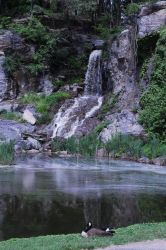
Morningside Park is a forest on a craggy cliff face located in Harlem, a black and Hispanic Manhattan neighborhood famed since the Jazz Age for its colorful artistic flavor.  There is a waterfall in Morningside Park which flows down a 50-foot precipice into a wide lily pond, perhaps reflecting the precarious nature of the neighborhood itself.  This is not necessarily a negative description, although the area has had its share of success and setbacks.  The lily pond teems with wildlife that has a mutually affectionate relationship with people, and the fierce nature of this relationship suggests the landscape is one of active and determined upward ascent. 

A Goose Visits the Pond
Every summer, children free their pet turtles to live in the lake, where dozens of the little creatures paddle alongside walkers on a nearby foot path and crane their necks to plead for food.  The turtles then retreat to a reed-covered island by the waterfall, where they pile up on rocks under weeping-willow trees to bask in the sun.  They share their weeping-willow island with graceful, snow-white egrets and tiny mud-brown sparrows, a flock of mallard ducks which aggressively patrols the lake, and a fat herd of Canada geese which protective local residents visit every ten minutes throughout the day with loaves of bread, crackers, and cake.  After all, no one else will remember to feed the geese if they don’t.  No one else loves the pond like they do.  


Daffodil012912Egret


“I told you to wait and eat slowly,” a lone bookish man in gold-rimmed glasses scolds at an eager goose padding behind him, wagging his finger at it.  “Now you have to wait.”  The walkway by the lily pond is thick with discarded bread crumbs, and a surrounding field is filled with placid strolling birds, baseball games, barbecue picnics, elderly bench sitters, bounding dogs and playing children.

In fact, the lily pond resembles a Central Park miniature, in which many of the best aspects of New York City’s grandest expanse are recreated on a neighborhood scale for personal enjoyment.  Like New Yorkers who spend up to $25 million for a brownstone on Central Park West, the Harlem residents who live near Morningside Park can walk one block from their doorstep to a place of maintained retreat and contemplation.  Landscaping signifies luxury, the power to create an idealized environment, and on its best days, the lily pond imparts a sense of New York abundance, a private pavilion for those who have earned their place in the city through extraordinary determination.  It also has an unmistakably challenging undertone—the lily pond landscape suggests that a ghettoized lifestyle is not some eternal byproduct of urban existence, a ubiquitous condemnation of city dwelling that must always accompany industrialized life or technological dependence, but one of many potential outcomes arising from choice and circumstance.


The reason for celebration at the sight of a successful waterfall pond arises from the former reputation of Morningside Park, which has still not completely disappeared.  This peaceful lakeside valley lies at the heart of a park once considered one of the most lethal in Manhattan, if not America, in the 1970s and 1980s.  It was well-known throughout the country among college students and tourists alike as a symbol of New York City’s irreversible urban decay.  Terrified students of Columbia University, an Ivy League bastion of perceived white educational privilege built just one block away in a gated community, were warned that just a few steps into the park would surely be their last, and that imminent attack by Harlem neighborhood gang members and drug addicts lurked within.  Some New York residents blamed local drug and alcohol use for the park’s deterioration.  Others believed a 1968 battle with Columbia, in which student protests derailed their university’s attempt to build a neighborhood gymnasium whose separate entrances for students and black residents had racist overtones, left a permanent pall of racial tension over the area.  Few on either side of this racially charged neighborhood conflict could easily forgive this clash.  The university waited for a new generation of students to erase the protests’ painful memory, and bitter resentments still simmer in a neighborhood which was permanently radicalized by the event.

Gymnasium  Columbia students tear down gymnasium site.

The lily pond was built on the site of this old gymnasium project in 1989, one of many restoration attempts started in 1981 by a group of Columbia students.  Some Harlem residents did express anger that such a newly planned landscape, however beautiful, would be built in the park with funds that could be spent restoring what already was there.  The lily pond project seemed yet another symbol, like the Columbia gymnasium, of the City’s assumption that black and Hispanic Harlem could not be entrusted to maintain a landscape of valued beauty, and that only white upper-class Manhattanites could gradually replace the hopeless site with something more genteel, and therefore worthy of maintenance funding.  Today, Morningside Park is surrounded by multimillion-dollar brownstones and condominiums, its nearby train stations and foot paths are safe enough for daytime use, and the park has a steady stream of visitors.  Because of these significant numbers, an army of volunteers is needed to keep the lily pond free of debris, but the ongoing fight against this deterioration is a predictable one of sustaining functionality in a crowded New York setting, rather than one of abandoned despair at broken race relations.


As such, the lily pond landscape holds a certain nostalgia for the past—of the Jazz Age becalmed, of radical politics reduced to a square of green earth and bland rituals of seasonal recreation.  But it also demonstrates the fulfillment of ownership, as the residents of Harlem descend on the park and wrest it from the clutches of its formerly dangerous reputation.  On a given summer Sunday afternoon, there are picnics by the lily pond crammed so close together they overlap, children with new puppies chasing geese and turtles, serious bespectacled teenagers discussing their latest homework on a site known as the Peaceful Dale by Dutch settlers in the area over three hundred years ago.  

Raccoon
 
Perhaps it already evokes nostalgia to some present-day visitors, as they imagine looking back in time, decades from now, on the gracious New York hideaway where they lived their most lighthearted moments, which their neighbors worked so hard to recreate in the image of a lost New York ideal.                              

Tuesday, January 31, 2012

Crossings and Boundaries: Moving through Manhattanville

Landscape transformation is ongoing, but can be exacerbated and accelerated by dramatic interventions both natural and human-induced (and of course both or a combination thereof). Such is the current case in Manhattanville, where Columbia University’s expansion project north of 125th Street into West Harlem is intervening daily to produce new spaces that consciously seek to integrate the worlds of the university and its surrounding communities. In 2005, Marilyn Taylor, one of the primary design collaborators on the project, wrote the optimistically titled, “Crossing Beyond the Boundaries: Columbia University in West Harlem.” In it she stated the intentions of the project:

“This twenty-first-century urbanity [of the Manhattanville extension project] is in direct contrast to the twentieth-century version that created the character and “gravitas” of the Morningside campus. The introspection and formality of this classic space created a magnificent presence. But it was one conceived as fundamentally separate from the surrounding city. In Manhattanville, we envision the energy of the city and academy flowing together. We hope this will create a place that is simultaneously “campus” and “not campus”” (Taylor 52).

But the transformation of a landscape (and even more, of the relationships of the people living in it) is obviously not just about the difference between what was before, and what is after. It is not only about the end result of spatial management and integration. It includes elements that are also temporal, active and social. It is about the transformation process itself – in this case, the period of time during which the area is under construction – and the social and political relationships that are produced, suppressed, and negotiated through the experience of living in that change.

Perhaps this is why a quick perusal of news coverage of the project over the past few years does not return many discussions of the final vision, critiques of the proposed design itself, or reflections on its historical comparability to the existing campus. Instead, and indeed somewhat predictably, I found criticisms of the intrusion of construction on daily lives, of enforced displacements, and of the shortcomings of administrative responses to these concerns that typically took “big picture” views. Furthermore, the complaints I read are not, as one might expect, primarily about the visual unpleasantness of waking up to a skyline of cranes, or walking past giant sinkholes. Instead, the complaints draw attention to other ways of knowing and living in an urban construction zone that emphasize its multi-sensory and multi-elemental nature – aspects of life that are not apparent in pristine urban design drawings and mock-ups, or from aerial views of that remove one bodily from the scene.In attempting to break down aesthetic boundaries as seen from outside and above, the project may well be re-inscribing numerous emotional and psychological ones.


I give two examples of affected non-visual aspects of the landscape here.

First, in the rush to examine the construction areas themselves, one might easily miss the very space that allows their examination: the streets.

You can find a list of planned closures and restrictions to streets (and consequently, movement through them) here. The list is not short, or uncomplicated. It requires one to consider the complex and often subconscious ways in which movement through a changing landscape reinforces one’s relationship to it, and how enforced changes to that relationship recreate power struggles and inequalities that are re-experienced every day.

Henri Lefebvre wrote that “Power seeks to control space in its entirety, so it maintains it in a ‘disjointed unity,’ as at once fragmentary and homogenous: it divides and rules” (Lefebvre 388).

What more effective way to divide and homogenize than to close and alter roadways? Streets are the spaces that allow movement from one place to another, that bring people together through and across a landscape, even as they emphasize the distinction between being in one place or another. When they are closed, all of the daily activities of life – businesses, commutes, leisurely strolls, shopping excursions – must be subordinated to the ends of the project. To close a road while subsuming the area around it into the university’s domain seems the ultimate example of Lefebvre’s observation.

The second example comes from an intended response to the first. As stated on the page linked above, New York City does not allow work on intersections during daylight hours, presumably to minimalize the spatial impact discussed (as well as, in all likelihood, for its own convenience, as the traffic from backed-up intersections would be much more difficult to manage and re-route). This means that as of February 13, work at the intersection of W 125th St and 12th Ave will take place between the hours of 10:00 pm and 5:00 am.

I quote, “This will include some noisy work.” This is clearly a problematic logistics issue, and I can imagine that once the decision to do work is taken, the scheduling of relative inconveniences is difficult. However, it does provoke consideration of the choice, a joint maneuver of city and developers, in the overall context of the project. Night construction provides yet another way in which the activity of transformation invades and re-structures local lives; noise pollution is always part of city living, and noise always refuses to stay outside, pushes itself past other physical boundaries and makes itself known wherever it finds itself. However, now this noise will not be confined even to daylight hours, when one expects to encounter the greater part of the rest of city noise. Yet another boundary is disregarded, and therefore thrown into high relief.

I conclude with another quote from Taylor, who writes that with the accomplishment of the expansion project, “The boundaries between the academy and the workplace will become less defined. So too will the distance between the city and the academy diminish. This will create a new urbanity, energized by learning, characterized by interaction” (Taylor 53). I cannot help wondering who is identifying the boundaries to be (un)defined, and the distances to be diminished, and to whose advantage the closing of this landscape might be.

Photo credits: Nathan Kensinger – more photos of the demolition can be seen here: http://kensinger.blogspot.com/2011/08/demolition-of-manhattanville.html

Drawing credits: Skidmore, Owings & Merrill with Renzo Piano Building Workshop

Cited works:

Lefebvre, Henri, 1974. The Production of Space. Donald Nicholson-Smith (Transl). Malden, MA: Blackwell Publishing Edition, 2011.

Taylor, Marilyn, 2005. “Crossing Beyond the Boundaries: Columbia University in West Harlem.” Places 17:1

Views from Columbia's Campus

Slowly Broadway -- the old main thoroughfare of the New Netherland colony to the City -- rises up along the hilly backbone of Manhattan toward Columbia University's campus (and then onward). Nowadays, walking along Broadway, the elevation is barely noticeable in the man-made canyons of New York City; so many of the original natural landscape features have been erased in this City..


The current Columbia campus is a bit like a castle, a prison, or an oasis, depending on your mood. A series of high buildings  surround and enclose a space that is open, sometimes green, sometimes claustrophobic. A fortress from the outside.


Depending on one's approach to the Campus, this castle-like quality of the campus may not be the first thing one notices. The Campus' entrance is in fact quite open: high open gates and trees welcome the visitor. In New York City, high imposing walls of buildings are nothing new and so are easily filtered out. Coming to this open space, one becomes aware that one has indeed reached the Columbia Campus. The University announces it presence. The visitor sees before her a straight path -- the College Walk -- leading straight into the clouds.


Following the path one comes to a great open plaza, where the highest point is taken up by a building marked "The Library of Columbia University". Although ironically this building now houses the university's administration, which looks down from its high point on the current main library  -- Butler Library -- on the other side of the main square. A cynic may say that Power goes over Knowledge here.


It should be noted that the point taken up by Low Library may not be the highest point in Manhattan as a whole (it is in fact in Bennett Park), but it is clearly one of the highest points on the island and certainly in the neighbourhood. The elevation of the point is only accentuated by the steep decline into the valley that has its lowest point around 125th Street. However, none of this is clear when gazing upon Low Library from College Walk, or even walking around Campus. As I said, the Campus shields off most of the city with its wall of high buildings. From the campus grounds there are only a few cracks in the wall; one instance being between the Schermerhorn and Fayerweather buildings.


Apart from this little alcove and the view from College Walk, there is another point where Columbia's elevated position in the city is made clear and this is at the The Charles Revson Plaza, that strange space that hoveres over Amsterdam Avenue in front of the Law School.


If it wasn't already, a strange eye-like statue makes clear what this place is about: looking out over the city -- on either side. Even though, the view toward the north (into the 125th Street valley) may be more spectacular, in fact the eye looks toward the south, toward the city, gazing down.


In conclusion, the campus of Columbia University appears to provide only two views: 1) as an enclosed space, buildings keeping the outside world out. Or 2) it provides vistas from above, such as Revson Plaza and College Walk. The campus appears to say: we are not really in New York City, we are in the sky! When we are on campus, we are sky-(wo)men, indeed: god-like - like De Certeau looking down on Downtown Manhattan, Wordsworth gazing on his favourite valleys, or Dante reaching heaven.

Monday, January 30, 2012

Invisible City


Over the course of three days, scientists pumped 10 tons of concrete into an ant hill.  After letting it set, the colony was excavated, revealing a structure of staggering complexity covering 50 square meters and running 8 meters deep.  In creating this archaeological site and revealing this unimagined landscape, one may assume that a large instance of ant genocide was committed in the name of scientific knowledge, but the extraordinary results trump countless formic murders.
The ants who built this particular colony moved out 40 tons of earth in the process of construction, with each worker carrying three times his own weight in soil on each trip. According to the video, it is the ant equivalent of building the Great Wall.

What was revealed is astounding.  A vast complex city-state with tubular roads and air vents and bulbous extensions, it looks space age in the contained environment manner of Charles De Gaul International airport with its connected travel tubes and pods.  It calls to mind Frank Herbert’s Dune with its underground drug mining society and giant worms.  These are the Invisible Cities that Italo Calvino didn’t write about. 

That there are such states below our feet, and that they are far more complex than the architectural and structural archaeological remains of many human sites, inspires awe.  The Maya inscribed their sculptures on their bottoms, acknowledging the gods beneath the surface, the divinity of earth.  As archaeologists, we are drawn to the hidden; we must remember to be open to that which we least expect.

http://www.youtube.com/watch?v=lFg21x2sj-M